Swimming with dolphins — we’ve all thought about it at some point, “it’s a cliché!” you’ll say. Everyone who, like so many of us, was moved watching The Big Blue once, twice, three times… (I’ve actually lost count!), has entertained the idea of diving into blue waters alongside one of the world’s most fascinating marine mammals. Everyone has secretly dreamed of one day gaining access to their elusive world, a world that touches the soul directly. And everyone who has had the immense privilege of watching them move through their natural environment knows the full purity and force of that inner experience; every time we meet their gaze, or rather their gaze settles on us, we suddenly become aware of the limitless nature of what we constantly try to confine ourselves within…
But while swimming with them remains an experience within reach of most ordinary mortals (that’s the good news), what about swimming like a dolphin? Now that’s a dream considerably less accessible to the average person, with a few rare exceptions… Alas, not everyone is Michael Phelps, record holder for the most Olympic medals across all sports, or Dana Vollmer, the American swimmer and triple Olympic gold medalist.
It was with this in mind that an American study conducted a unique scientific experiment in the lab, attempting to understand Dana Vollmer’s athletic performance. “Motion capture” specialists placed motion sensors across the swimmer’s entire body to record and build a 3D model of her movements through the water. Using a series of waterproof markers positioned on the young woman’s body, various cameras tracked and recorded the undulations created as she swam. According to Chris Bregler, a computer scientist at New York University, “these sensors allow movements to be tracked precisely thanks to highly advanced cameras” despite the disturbances caused by water. The software then collects and assembles the recorded data, producing a map showing the location of each sensor. All that remains is to model the markers’ trajectories on a computer and compare these movements to those of a dolphin. The results are striking! The images show a remarkable similarity between the swimmer’s kicks and the cetacean’s tail movements. Even more surprising, it would seem that the Olympic champion’s ability to almost perfectly mimic a dolphin’s swimming motion partly explains her extraordinary performances, including her world record in the 100m butterfly at the London Olympics.
So, if your dream is to swim like a dolphin, you know what’s left to do..!
Click here to watch the video of the experiment conducted in the United States with Dana Vollmer, or visit the following site: http://manhattanmocap.com/olympics2012
What we know about dolphins, in a few words:
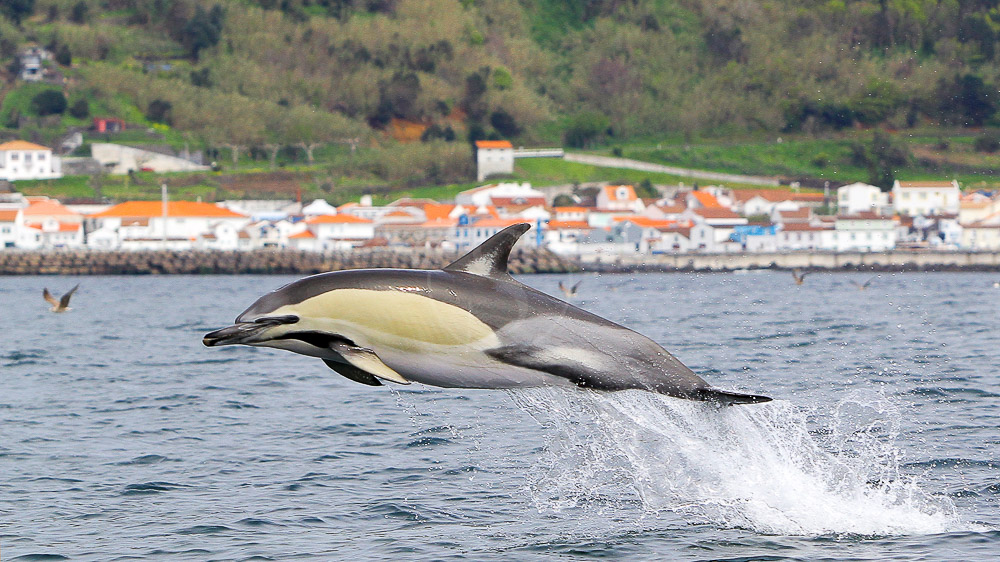
The term “dolphin” refers to numerous toothed cetaceans under 5 metres long with an elongated rostrum. There are more than 30 different dolphin species worldwide, including the Delphinidae (dolphins living in seas and oceans) and the Platanistoidea, among which are the freshwater dolphins. Among the best-known species is the bottlenose dolphin, Tursiops truncatus (its most famous representative being Flipper): it is the largest of the dolphins, measuring between 2.5 m and 4 m long and weighing up to 300 kg. Living in tropical and temperate waters, it is found near coastlines, in groups of around ten individuals. They travel great distances in search of food, at speeds of around 20 km/h. Other species include the common dolphin, Delphinus delphis (the most widespread species, living in tropical and temperate waters); the beluga, known as the “white whale” or “sea canary”, which lives in the seas of the North Pole; and the Amazon river dolphin or boto (Inia geoffrensis), a freshwater dolphin found exclusively in the waters of the Amazon or Orinoco, from the South American estuaries to Peru and Bolivia.
Protecting dolphins: a necessity
Read this New York Times article published in 2011 on the rivalries between Amazon fishermen and pink river dolphins, which unfortunately bear the cost of human ignorance and greed… Note: this article is in English.
The baiji, or Chinese river dolphin (Lipotes vexillifer), was officially declared extinct in August 2007, although a few individuals may possibly still exist.
Click here to open the New York Times article.
Did you know?
A team of American neurologists discovered in 2005 that marine mammals can go several weeks without sleeping! By studying the behaviour of young dolphins and their mothers, researchers found that newborns do not close their eyes during the first weeks of life. It takes them several months to adopt the normal cetacean sleep pattern of 5 to 8 hours a day. During this period, young dolphins must surface to breathe every 3 to 30 seconds in order to survive; their mothers watch over them continuously and therefore do not sleep either. This case is unique in the animal kingdom! Indeed, any sleep deprivation normally causes serious physiological disruptions that can lead to death. Many other studies are underway to better understand dolphin behaviour, their hunting techniques, how their sonar works, and more. No doubt fascinating discoveries await us in the future!
Keen to encounter dolphins for yourself…
Take a look at these examples of tailor-made journeys organised by the Étendues Sauvages team: dolphin encounters in the Azores or a cruise on the Rio Negro in Brazil, with the possibility of seeing pink river dolphins swim

Whale watching in the Azores
Share your own dolphin adventure with us by leaving a comment on this article.
We’d love to hear about YOUR experience during a trip or an outing at sea, and share it together.
Talk soon,
PS: A gift for die-hard fans of Luc Besson’s The Big Blue: a clip from the soundtrack, click here!