Beverly and Dereck Joubert have lived their lives in close connection with the African wild. They are an inspiration and a symbol for Étendues Sauvages’ journeys across Africa. We wanted to interview them to share their experiences.
Étendues Sauvages: What is your earliest bush memory?
Dereck: We both grew up in South Africa, and from a very young age we visited nature reserves such as Kruger. I remember seeing an elephant for the first time at around 4 or 5 years old and falling completely in love with these animals. I told myself I hadn’t been born into the right family — that I should really have belonged to a family of elephants!
That encounter meant that, first alone and then together with Beverly, I led my life — at school, at university, in the bush or at work — according to what I call the elephant ethic: altruistic compassion, dignity, grace, communication, collaboration. Those early experiences shaped the following sixty years of my life.
Beverly: Growing up in South Africa, my parents always took me to reserves across the country. The anecdote that comes to mind is of a beautiful lilac-breasted roller. It had been hit by a car and was injured on the track. I couldn’t bear to see injured animals, and my instinctive reaction at that moment was to want to save it. I asked my parents to stop and pick up the bird, but they told me I shouldn’t get out of the car because there were dangerous animals around. I jumped out anyway and picked up the roller. The next step was to get it treated. We drove to the nearest safari camp, where people probably thought it was a bit mad. But they were very kind to the little girl I was, determined to save that bird. I think my compassion began in those early years with my parents. Like Dereck, I was fortunate to have these wonderful experiences of discovering the wild, and we both began our lives as young explorers. When Dereck and I met, we realised we were kindred spirits, and that we would now live these adventures together.
Dereck: This question raises another one: in today’s world, what nature experiences can young people have, experiences they can learn from and that will shape their lives, as ours did? When you think that New York has 8 million inhabitants, Sao Paulo 20 million, for instance — where can young people go to have the same experiences we had? There is often a nature deficit in the youngest generation today.
Travelling to Africa can fill that deficit and become a profound, formative experience.
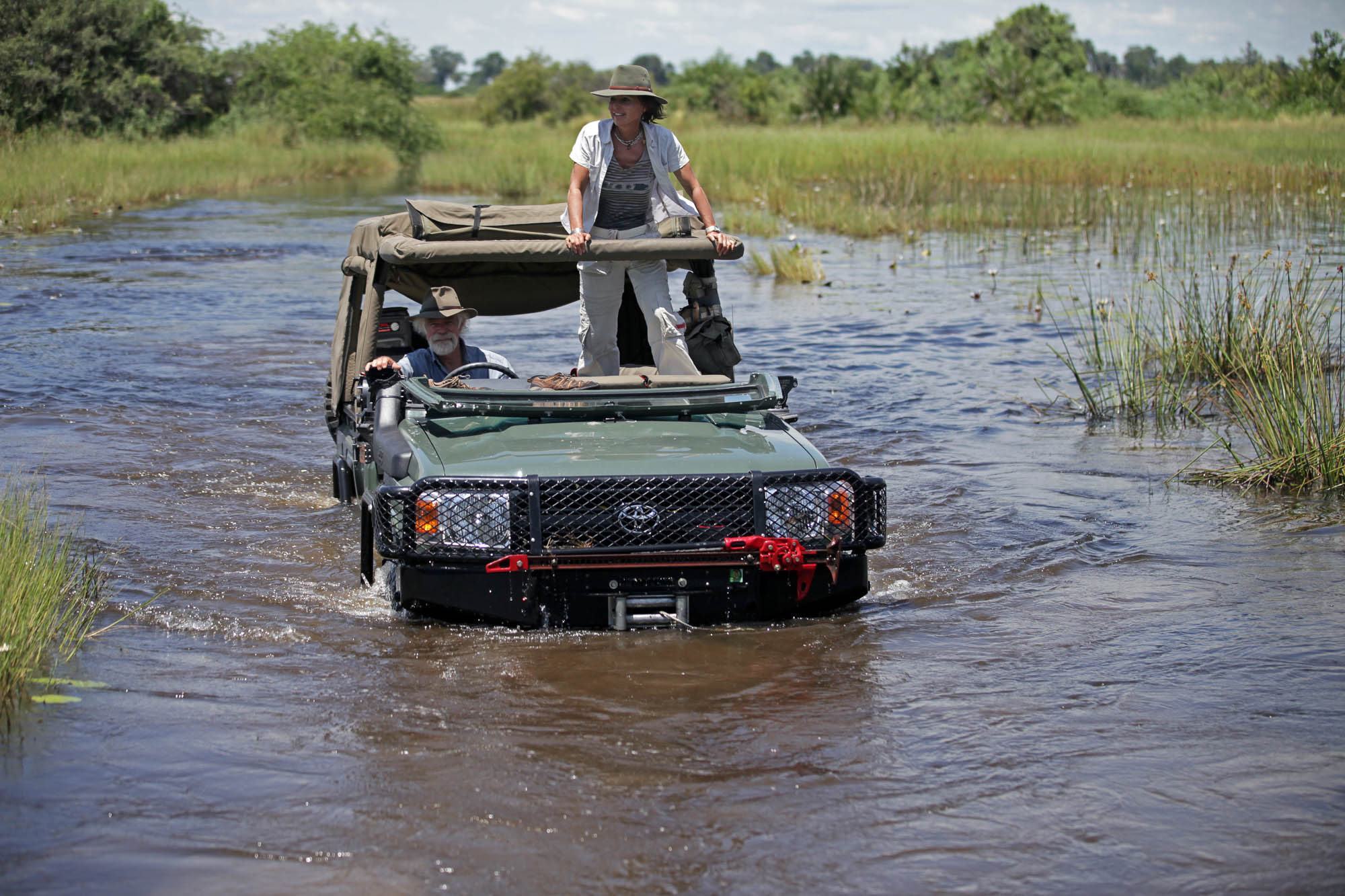
Beverly and Dereck Joubert © Wildlife Films
ES: What struck me watching your work is the importance of the senses. What role do the senses play in your discovery of wildlife? How does this differ from urban life?
Beverly: We see across the world today that almost everyone is cut off, disconnected from nature. But to survive in the wild, and also to do our work as filmmakers, Dereck and I have to commune with nature. To do that, we have to be freed from what usually clutters our lives: noise, music, our phones. All the senses matter enormously to us; we need to be able to read the information they give us, as if we were wild animals ourselves — and indeed we are animals, even if we tend to forget it. We have to pay attention to the calls of the animals around us and be able to interpret them, such as alarm calls given at the sight of a predator. Those calls can lead us to a leopard, a cheetah or a lion. So it’s essential that we are fully immersed in nature, with all our senses alert. Smell can also tell us something — whether an animal has died nearby, whether there’s danger close by, whether rain is coming and we need to take shelter, or whether something is happening with the animals we’re filming. By understanding what our senses tell us, we can behave naturally and never be intrusive with the animals. In fact, we never intervene in a natural situation. But if it’s a situation created by humans, where an animal has been injured, then we may step in. To sum up, I find that being in nature fills my soul, and when I’m out there, I feel whole and complete.
Dereck: When we fly our little Cessna, crossing the border towards the Okavango Delta, I can smell that unique mix of wild sage and elephants, even at 2,400 metres — that scent tells us we’re home.
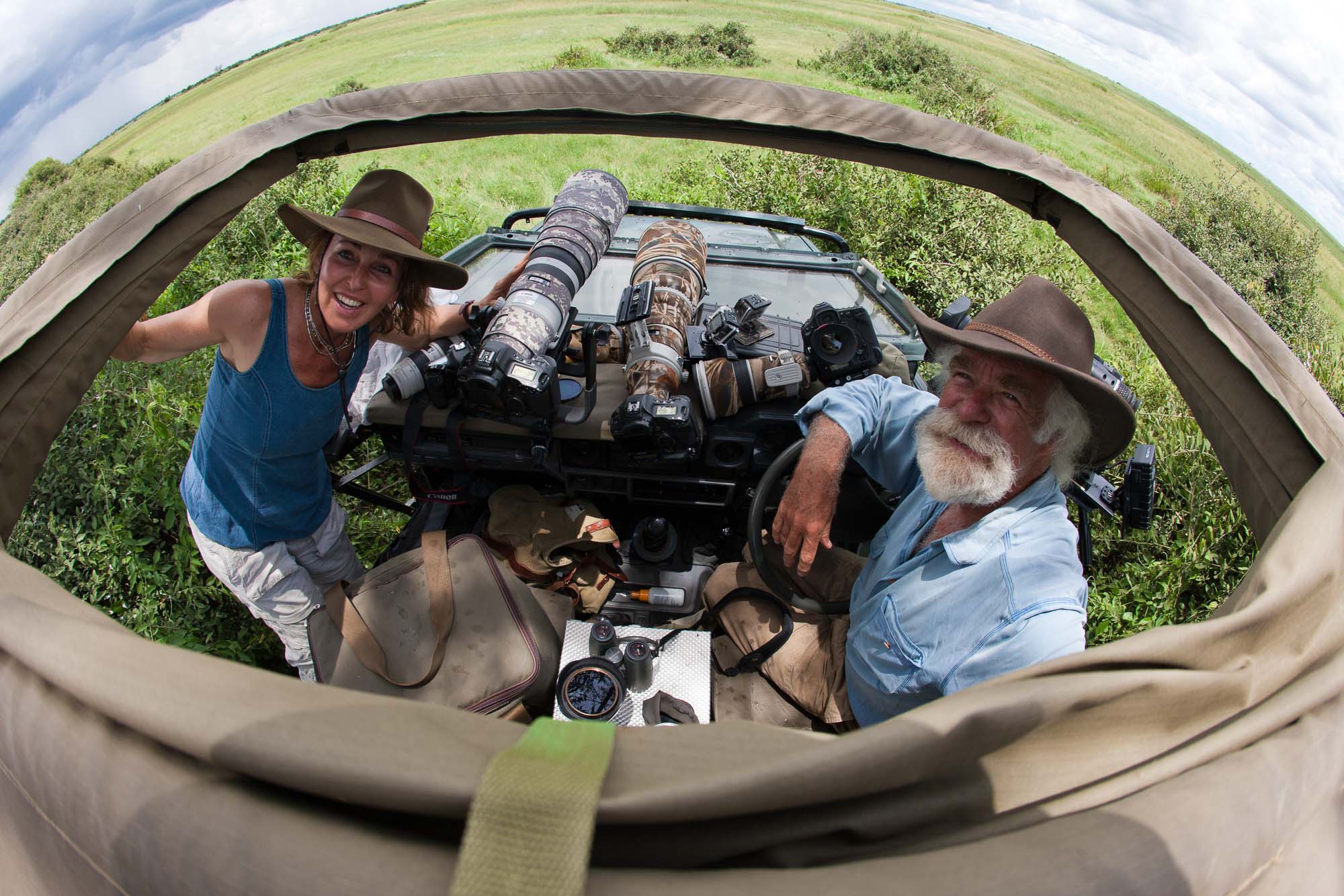
Beverly and Dereck Joubert © Wildlife Films
ES: How did you meet, and how did your careers begin? Would you say being a couple helped your careers and choices, or was it an obstacle?
Dereck: We met at school. I went off to do my military service, then went back to university, while Beverly continued her studies and started working. By the time we finished our studies we were already a couple, and we headed into the bush to discover Africa. We were born in Africa, but growing up in South Africa doesn’t give you the full picture of the continent in all its facets. We first explored South Africa a little, then quickly moved on to Botswana. We fell in love — not only with each other but with Africa. We are children of this continent; Africa runs in our veins and is part of our DNA. Discovering that together mattered to us.
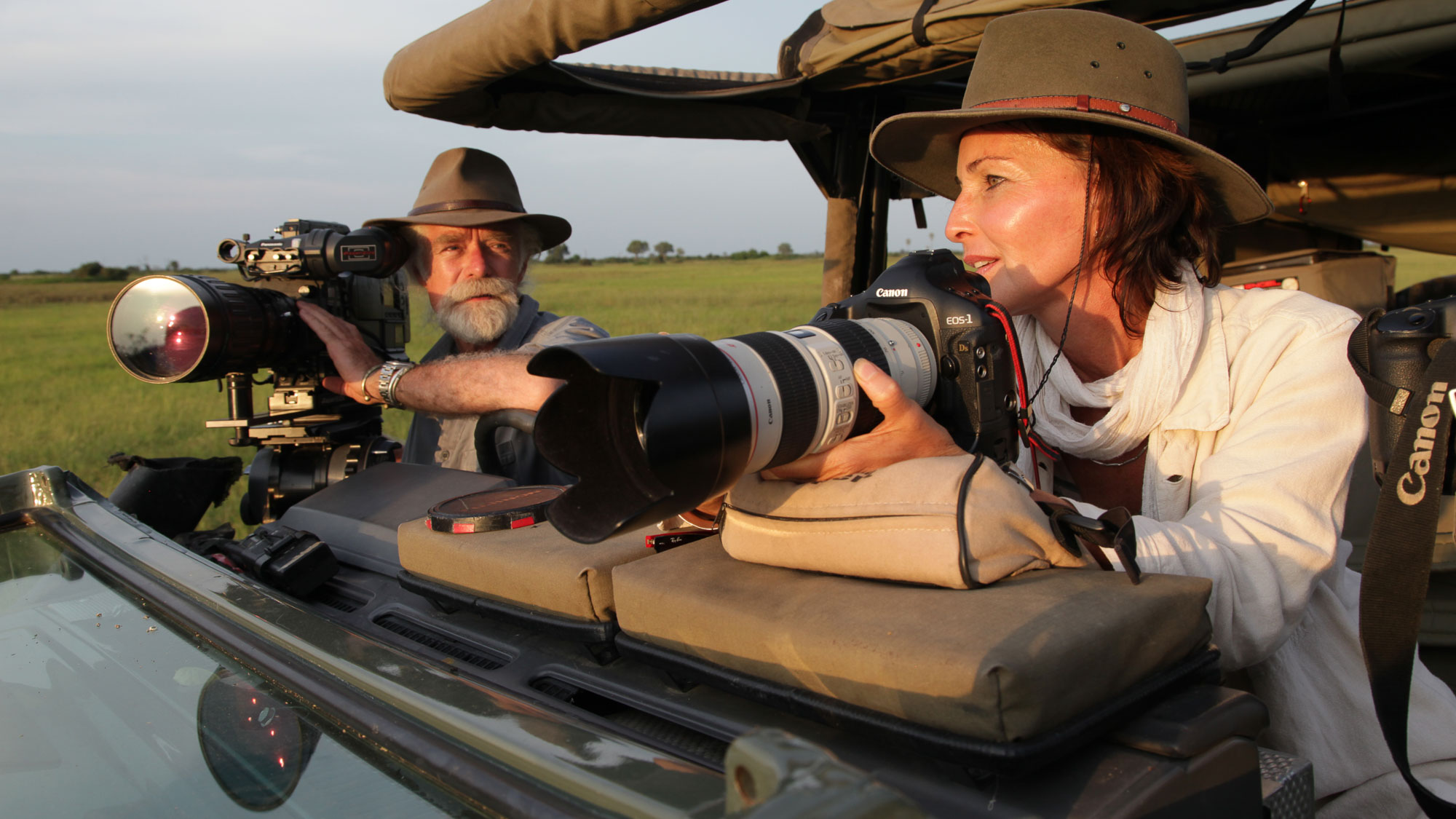
At one point, while we were studying lions at the Chobe Lion Research Institute in Botswana, I picked up a camera and handed my still cameras to Beverly. At that moment we literally transformed into a filmmaker and a photographer, respectively. From there we built our careers together, side by side. An obstacle? [smiling] …
Beverly: [Laughs] I can’t think of any way being a couple was an obstacle. We always wanted to devote our lives to exploring, to discovering the unknown, and of course to filming those discoveries and bringing the wonders of the world to light. I think we managed to do that quite quickly, because instead of hiring filmmakers to help us in our new career, we learned and acquired every necessary skill ourselves. We produced, we directed — I handled sound, Dereck handled the images and the script, and in the very beginning we even edited in the field, straight out in the bush.
We only ever brought in a composer, with whom we worked closely. Today, with films being digital, we work with an editor, but apart from that, Dereck and I are a team; we share this passion and have a remarkable yin-and-yang relationship. That gives our films a particular atmosphere that people notice, and I think it comes from that balance between the masculine and the feminine. We sometimes feel a scene differently. For instance, I might react more emotionally to a hunting scene than Dereck does. We discuss it during editing, and those different perspectives can come through in the film, because we’ve always wanted audiences to feel what we felt. That brings to mind our film “The Last Lion.” A lioness had three cubs. They came up against a herd of buffalo — one cub was killed, another disappeared, and the third had its back broken. The lioness was left with just that one cub, with a broken spine.
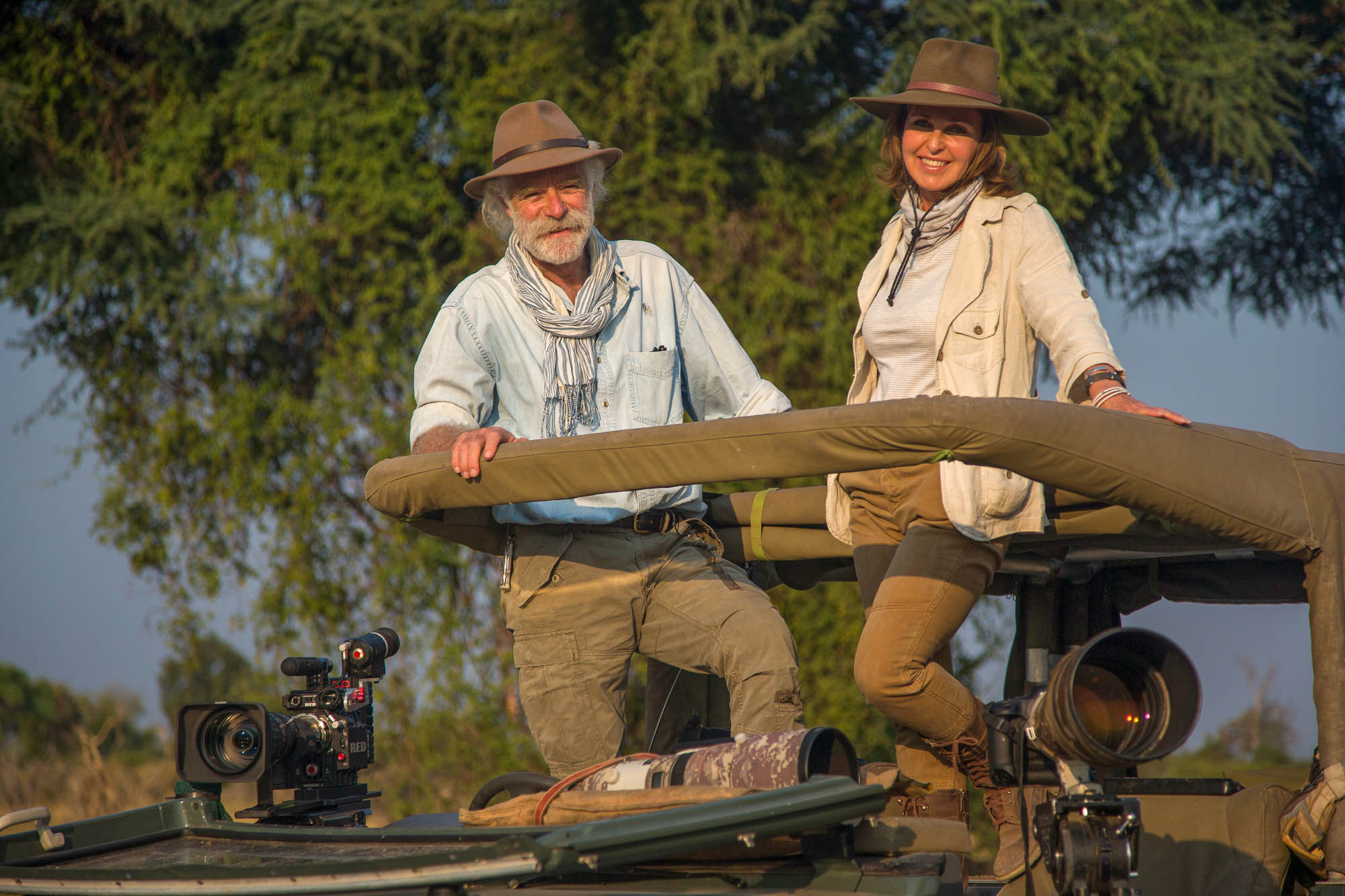
Beverly and Dereck Joubert © Wildlife Films
She had to make a decision, and in the end abandoned her cub, because she knew there was nothing she could do. We could sense this lioness’s grief, and we felt an immense grief ourselves. That comes through in the film, which made the audience share the same emotions.
Many people wrote to us saying they felt as though they had lived the scene themselves. Some asked whether we hadn’t wanted to try to do something, and of course we wanted to — but we had to hold back, because it was a natural situation.
Dereck: We often talk about this balance between science and emotion. If one of us finds an event harder to deal with, the other can help them through it, if they’re not feeling the same thing. That’s one of the real benefits of this close, lasting relationship over these 40 years.
ES: You have often discovered things that were unknown until you witnessed them, filmed them and shared that discovery through your images. Could you give us some examples?
Dereck: There are many, because almost all our films present things that were previously unknown. When we first met National Geographic, they asked us where this place was where we had made our films — they had never even heard of Botswana. So simply introducing Botswana to the world through our camera lenses was already something new.
Early in our career in Botswana, the Savuti River dried up. No one had realised that rivers could run dry — rivers that were home to hippos, elephants and crocodiles. The film that launched our career, “Eternal Enemies”, revealed the intense relationships between lions and hyenas. Until then, the scientific world believed hyenas were scavengers lurking in the dark, never killing any proper prey themselves, while lions were the “kings of the jungle”. In fact, hyenas are often the ones that hunt and kill prey, while lions scavenge.
That was a major scientific discovery.
Beverly: In another film, “Ultimate Enemies”, lions station themselves near a waterhole at the height of the dry season. It’s the only water source between two rivers, and elephant herds converge there. There were so many elephants that when a matriarch left the waterhole and called her herd to move on, some members sometimes failed to catch up — most often calves of 4 to 5 years old who couldn’t find their family again. That’s when the lions began attacking young elephants. It was a scientific discovery.
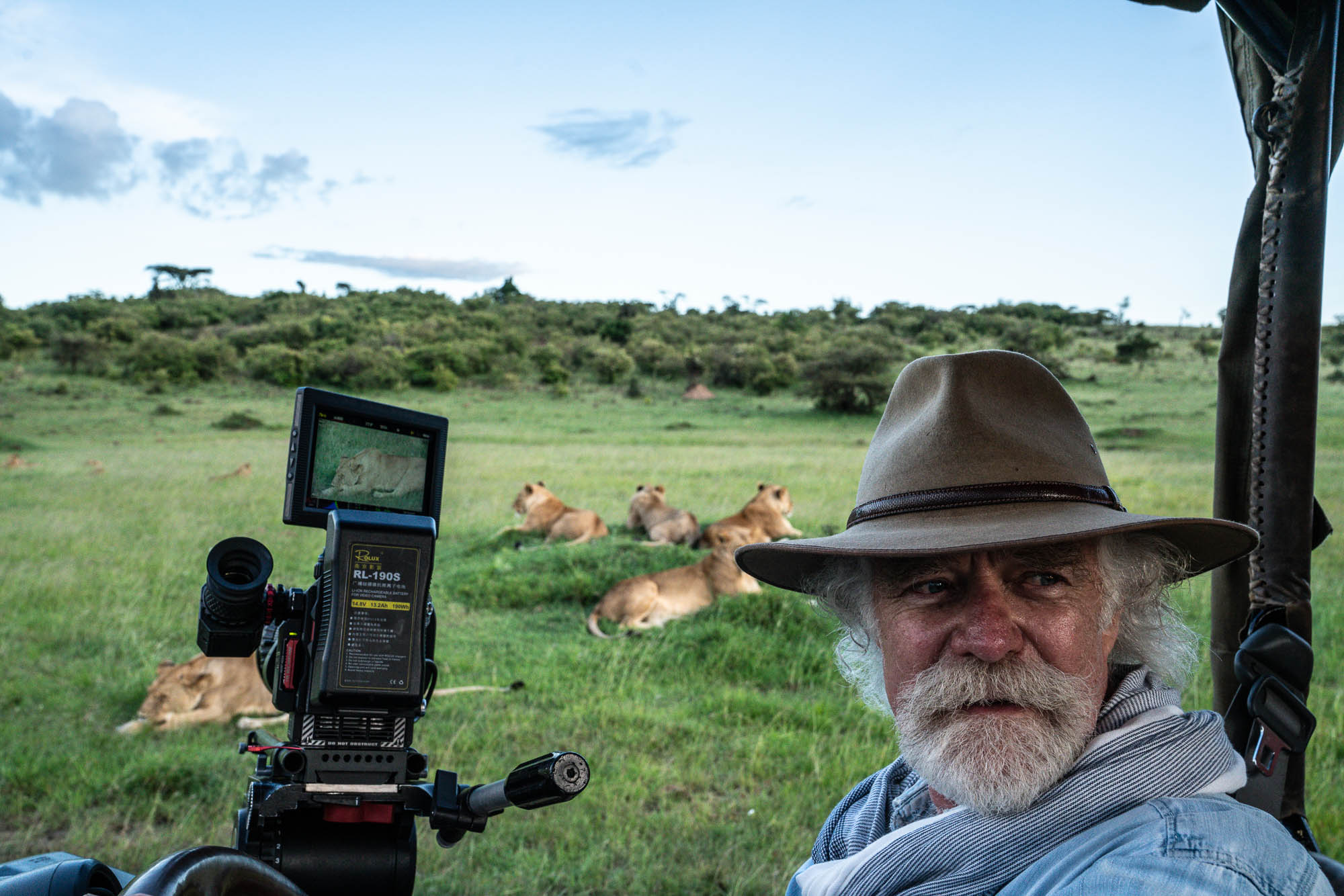
Dereck Joubert © Wildlife Films
One night, at two in the morning, we found lions attacking a young elephant of about 2 years old. That too had never been filmed, nor was it known to science.
Another event we filmed was particularly eye-opening for us. At the time, we were making a film about a young female leopard we named Legadema, whom we filmed for three and a half years. One day, when she was still very young, around 16 months old, she hunted a female baboon that had just given birth, with the infant still clinging to her fur. The leopard apparently had no idea the baby was there until she noticed movement when the infant fell from the tree where she had hauled her kill. The leopard leapt down in reaction to that movement.
The baby baboon was so innocent that it reached out its hands to the leopard, as if asking to be cared for. The female leopard seemed genuinely torn between acting as a predator and acting as a mother. She hadn’t been a mother yet, but she was approaching that stage of her life. Something very interesting happened then. Instead of acting as a predator, she picked up the baby baboon carefully, as if it were her own cub. She carried it up into the tree and looked after it. It was the middle of winter, and she kept the baby baboon tucked into the curve of her neck to keep it warm through the night. Of course, the baby baboon couldn’t survive, since it needed to nurse, but the leopard did not kill it.
The footage we captured of that scene was entirely unprecedented. Among the messages we received after that film, people pointed out that if this could happen between a predator and a baboon, perhaps one could imagine a world without wars. Still, it was a truly unusual situation.
“YOU QUICKLY REALISE WE ARE NOT ALONE“
ES: You have previously described your life as having gone through several phases. Would you say these phases coincided with the evolution of biodiversity over time?
Dereck: Absolutely. When we left university, we set out to discover Africa. We were in awe of its beauty and complexity, and our first films focused on discovering and celebrating Africa. You can see that in films such as Stolen River, Forgotten River, Eternal Enemies, and even Reflections on Elephants. After about 10 to 12 years, though, we began to realise that not everything was rosy. Zebras were being hunted for their hides, elephants for their ivory, and lion numbers were collapsing.
We then went through a period of questioning that lasted about 10 years. Our films from that time express our uncertainty about the future of these magnificent things we were filming. How much longer would they still be here? Then we entered a third, more activist phase of advocacy and defence of nature and wildlife. Our message was that we had to change how we acted if we wanted to prevent their disappearance. After that we took it a step further and decided to roll up our sleeves, moving out of the documentary world and fully into conservation — not just to spread the message of conservation, but to carry it out ourselves.
ES: When did you decide to create Great Plains Conservation?
Dereck: We discovered that while we were filming Legadema, the female leopard, 10,000 leopards had been killed legally, under hunting permits. So we created the Big Cat Initiative with National Geographic to try to protect other Legademas and all the other big cats — lions, snow leopards, jaguars. We found that all these populations were collapsing dramatically, by around 95% over the span of our lifetimes up to that point. We quickly realised that saving one leopard at a time wasn’t enough. We needed to protect wild spaces large enough to shelter hundreds or thousands of predators at once. A great idea — but how to fund it? That’s where tourism came into the equation, and the creation of our company, Great Plains, to fund the protection of large wild spaces. Today we manage just under a million hectares of wild land, specifically chosen to shelter Africa’s great iconic species. As a rough extrapolation, this allows us to shelter and protect, as best we can, around 2% of the world’s elephant, lion and buffalo populations, for example. Even though 2% may not sound like much, these spaces will play an increasingly important role as populations collapse around us, and as we acquire more land. Great Plains is thus becoming a guardian of increasingly rare species.
Beverly: These lands are not national parks; they are lands adjoining national parks. They serve as buffer zones along park boundaries, or as corridors between protected areas.
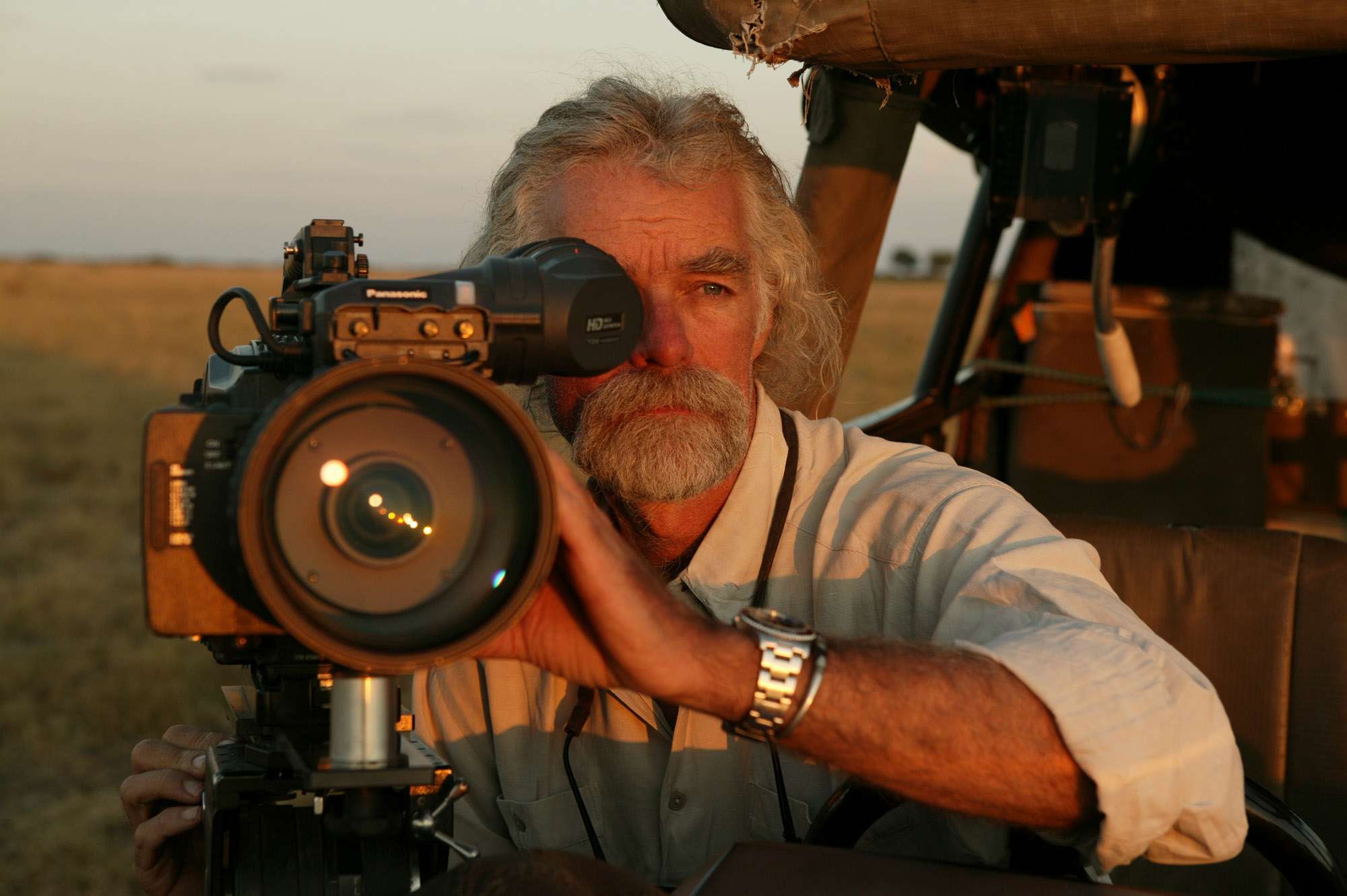
Dereck Joubert © Wildlife Films
ES: Do you buy this land, or do you manage concessions?
Dereck: Generally speaking, we don’t buy land, because when you buy land, the conversation often stops the moment you’ve paid — even though in Botswana things are usually better organised than elsewhere. If you lease or manage land on behalf of a family or a local community, you become partners. And partnership is key to the future management of Africa’s wild spaces.
ES: 20 or 30 years ago, conservation efforts focused on protecting an area by sealing it off, in a sense, cutting it off from the public and from local communities. Would you say you take a holistic approach, since in your view that’s the only way to be sustainable and to succeed?
Beverly: Absolutely, it’s the only way to achieve lasting results. I like the word “holistic” because that’s exactly what we do. By involving communities, we help every one of their members become ambassadors for these lands. After the pandemic, we all understood more clearly the role tourism plays in protecting these regions. Communities must be included in conservation; they must embrace change and become that change.
Dereck: If we want to survive beyond this century, we have to recognise that the real goal would be to keep roughly half the planet intact, wild. That’s where most of our money needs to go now — to protecting our natural capital. We need to help people look beyond immediate, short-term gains and towards sustainable benefits that don’t erode the planet’s natural capital. That can be achieved through partnerships.
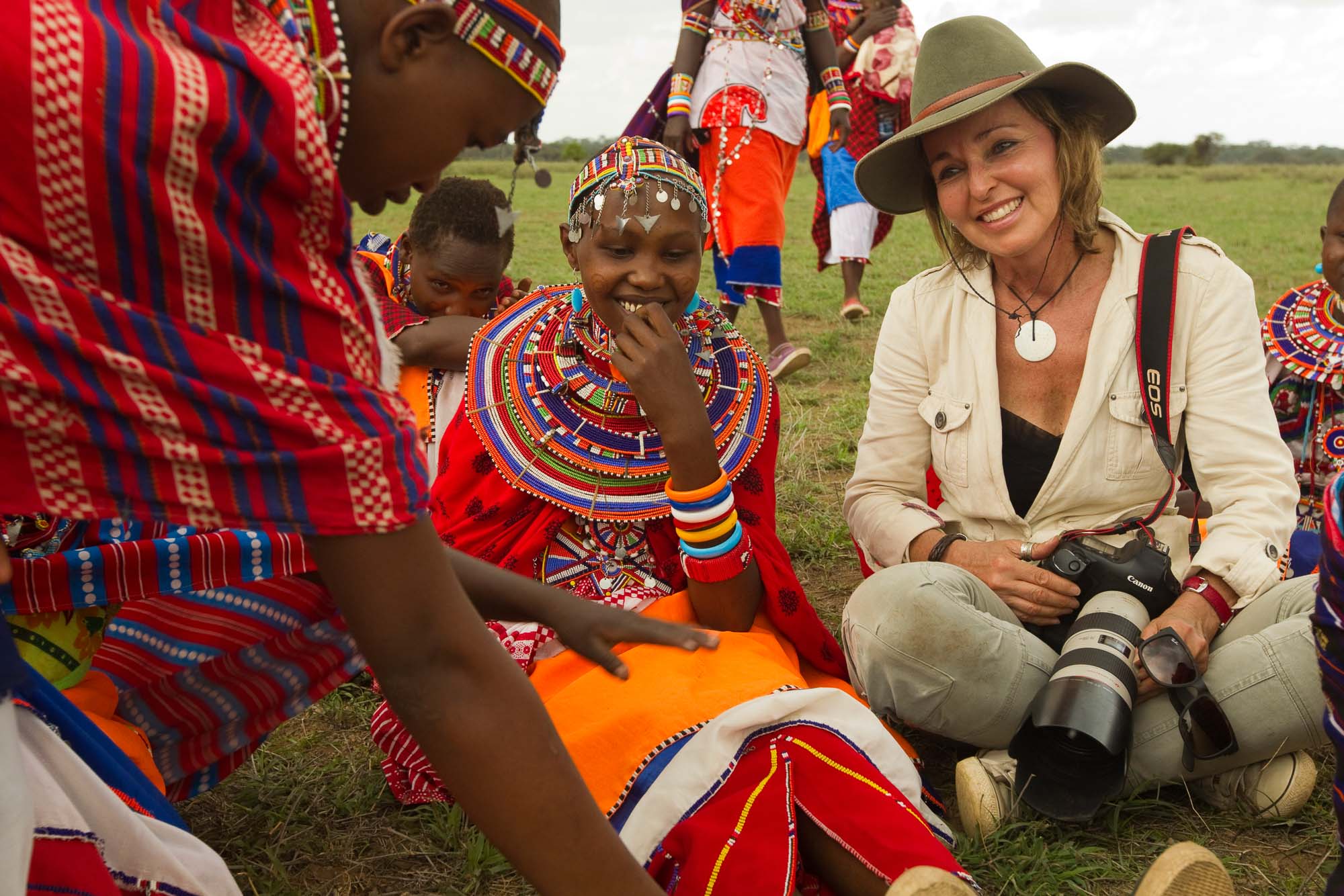
Beverly Joubert © Wildlife Films
ES: What anecdote would you give to explain why you’re so attached to the bush, and what has been the guiding thread of your life?
Dereck: That’s a hard question. If you look into the eyes of an animal such as a leopard, you quickly realise we are not alone. We are not the only conscious beings. So we have to respect everything around us. Our company’s approach is to be caring, to feel concerned, to be empathetic — whether in running our business, interacting with each other, or interacting with animals. I think that’s what has guided our whole lives, because when you look through those animals’ eyes, you see their soul, and you realise that, give or take a few nuances, they are human too, in a way.
Excerpt from the book “At the Heart of Nature – Volume 1”
Interview conducted by Delphine Dubray in August 2023, for Étendues Sauvages
Committed programmes
– Big Cat Initiative with National Geographic: a team of biologists, conservationists and explorers working in the field since 2009 to protect big cats. 128 projects across 28 countries, 7 iconic species protected across more than 1,800 sites, 4,500 lions saved.
– Rangers Project: 9 countries, 16 partner projects, 152 employees.
– Rhinos Without Borders: relocation of 100 rhinos from South Africa to Botswana.
– Sapi Reserve Restoration Initiative (Zimbabwe): a 120,000-hectare area on the Zambezi River bordering Mana Pools National Park. A programme combining a strategic wildlife management plan, the development of basic infrastructure, roads and communication systems, and an ecotourism operation (Tembo Plains).
Why keep doing tourism in Africa?
– Urban life has created a nature deficit. Travelling to Africa fills that deficit and becomes a profound, formative experience.
– Responsible tourism that carries real meaning should be encouraged. Its first virtue is contributing to the protection of wildlife.
– Active tourism drives most economies across Africa.
– Travelling supports jobs. The livelihoods of several thousand people depend, directly and indirectly, on the real benefits of tourism.
– People from local communities are trained in a range of professions and can go on to take up other positions. There’s a genuine positive spiral of skills transfer.
– Of course, it’s possible to calculate a trip’s carbon footprint and sponsor tree planting on the ground in Africa.
– But the benefits of tourism go well beyond that, and this holds true in Africa: travelling far from home broadens the mind and brings people closer together. That is tourism’s greatest value.