September is already on the horizon, marking the end of the great summer migration for many of you. As every year, millions of French, Europeans and others headed south in July and August for sun, good spirits, rosé and antipasti… By car, train, boat or plane, they then took the roads home, promising themselves they’d return next year…
Does this make us great migrators of modern times, akin to the many animals that periodically travel thousands of kilometres in search of less hostile territories? Perhaps a primitive, gregarious instinct (in the zoological sense) still lingers within us, which, mixed with our utopian wish to see ourselves as “seekers of gold and of elsewhere,” drives us to repeat the same ritual every summer.
At fairly precise times of the year, millions of birds, insects, terrestrial and marine mammals, fish…, driven by an instinct to preserve their species, leave a given territory for another, richer in food, more welcoming to their offspring…, spend a season of their life there, then set off again toward their place of origin. Could it be this same instinct for self-preservation that drives us toward milder skies?! Just as other animals flee arid lands in search of water and green grass, we too may be striving, in our own way, to escape a hostile environment made of stress, fatigue, gloom and routines that have become unbearable.
Wildebeest, these tireless walkers
Watch the remarkable video by Will and Matt Burrard-Lucas, which beautifully retraces the incredible saga of the wildebeest across the plains of the Serengeti. Does it remind you of something? I’ll let you be the judge…
[media id=12 width=560 height=315]
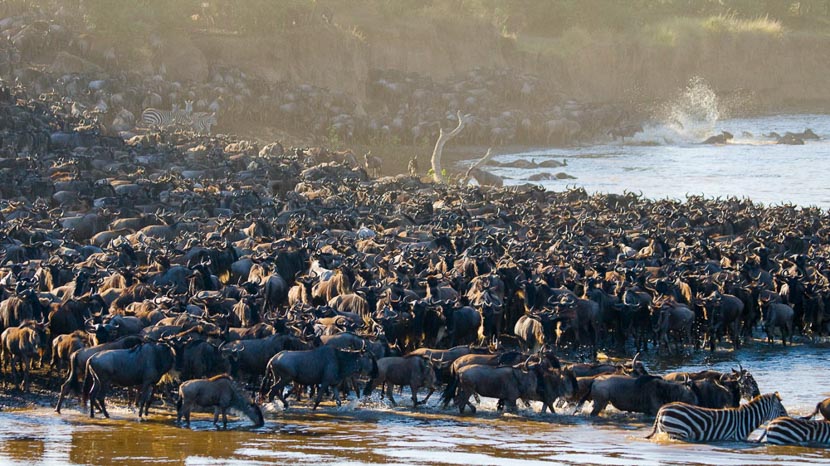
Every year, periodically, depending on the rains, the great wildebeest migration animates the vast plains of the Serengeti between Kenya and Tanzania. Starting in March-April, between one and two million wildebeest leave the southern plains to begin an endless trek in search of water points and tender green grass, crossing Serengeti National Park, a UNESCO World Heritage Site (spanning more than 14,000 km2, it is the second-largest park in Africa).

The wildebeest migratory route differs from other great migratory paths, which generally go in a straight line from one point to another. These large herbivores instead make a circuit around the Serengeti, moving clockwise. Around May-June, the wildebeest continue along the western corridor of the park, then reach the north of the park around July, on the Kenyan side, from where they set off again in October, finally returning south in December. A journey lasting 7 to 8 months!
One of the most spectacular, yet also most brutal, moments of this long trek is the crossing of the Mara (or Talec) River, in the north of the Serengeti, a place fraught with danger for the wildebeest (the weakest drowning, crocodile predation…).
Migration, a form of natural selection
While migration allows animals to find territories more favourable to the survival of their species (grazing grounds, breeding sites…), it also lets natural selection do its work. During the long trek, many individuals will be caught by predators (particularly the youngest), and weak or sick animals will never reach the final destination. Only the strongest will complete the journey unscathed and go on to mate, giving rise to hardier offspring that favour the survival of the species.
Watch the wildebeest migration on a map by clicking here. (then click on the “Migration Map” tab to open the map, as well as the red “See migration” link at the bottom right to view the animation) 🙂
And you, which camp does your heart belong to? Are you more of a great migrator or a seeker of elsewhere?
Let us know by leaving your comment at the bottom of the article.
See you soon for more wild chronicles,
Want to live the African adventure, at the heart of wildlife…
Immerse yourself at the heart of the Masai Mara, in Kenya, and witness nature’s great story unfold live: see an example of a tailor-made journey here.
Let yourself be guided through northern Tanzania, for unforgettable wildlife encounters.