


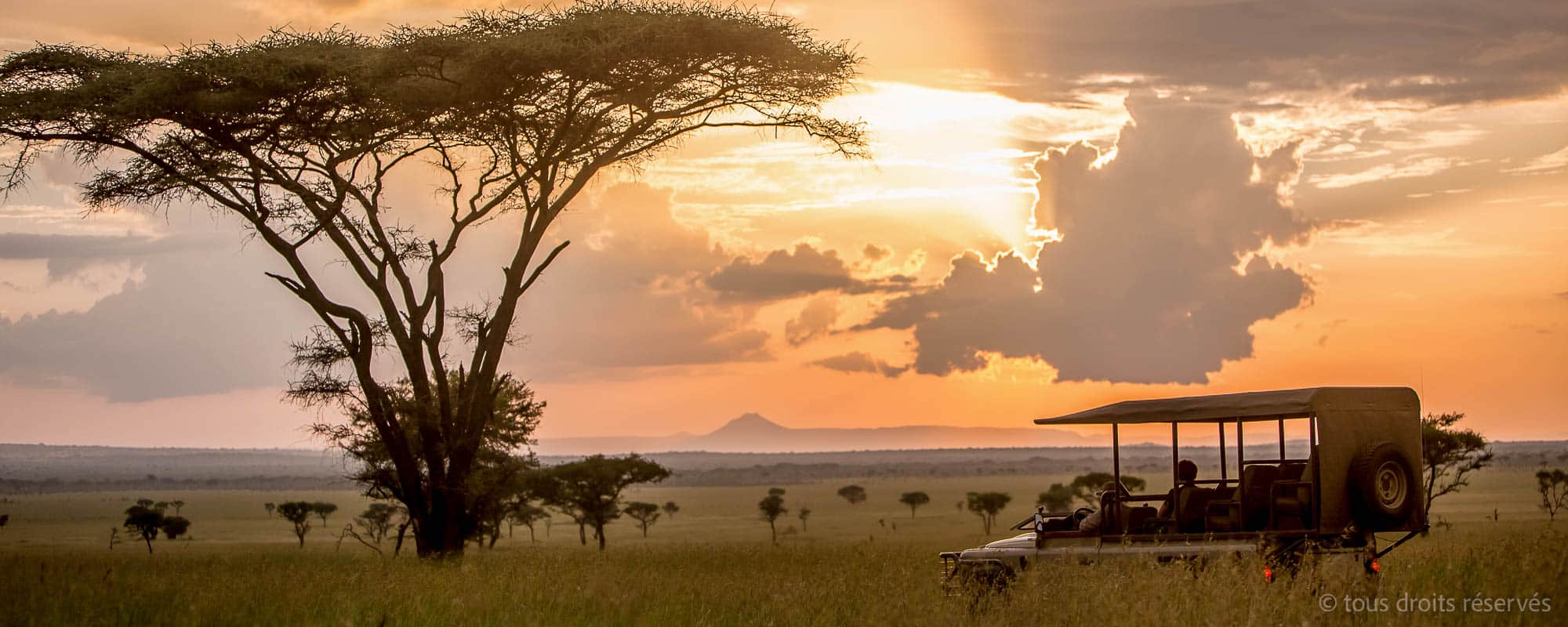
Luxury safari in Tanzania © Singita
Luxury safari in Tanzania
Africa as we dream of it
Luxury safari travel in Tanzania
Read more CollapseThe luxury of safari through experience


We design your tailor-made safari in Tanzania
Why travel to Tanzania
- THE HIGHEST WILDLIFE DENSITY IN AFRICA
- PRIVATE SAFARIS
- AN IDEAL COUNTRY FOR A SAFARI-AND-BEACH COMBINATION
- FLY-IN SAFARI FROM NORTH TO SOUTH
A favorite of ours


Nuit sous les étoiles à Mwiba
By Stéphanie, Tanzania specialist: “At Mwiba, nature isn’t something you watch. It’s something you live. Under an endless sky, somewhere among the rocks of Mwiba, the night wrapped around me. No walls, no roof — just the rustle of the wind, the distant calls of hyenas, and thousands of stars hanging like suspended spotlights. Lying on the bed, the fire crackling softly, the Milky Way traced a path toward the unknown. Everything was silent, and yet everything hummed with life. A simple, suspended moment, impossible to forget.
Discover this favouriteConsult us to design your tailor-made journey
When to go on safari in Tanzania
Your questions / Our answers
Can you meet the Maasai people in Tanzania?
We can’t talk about Tanzania without mentioning the Maasai. They are one of Africa’s most emblematic peoples, and talking with them is genuinely enriching.
Mindful of ethics and respect for local populations, as well as the environment and animal welfare, we favour the most natural encounters — perhaps along a walk or around a campfire — rather than the typical Maasai village visit, where the encounter tends to be commercial, folkloric and awkward rather than traditional.
What animals can I see in Tanzania?
Almost every species of the African savannah, and large herds too!
Northern Tanzania is one of the places in Africa where the concentration of wildlife is most spectacular.
Beyond the migration, which promises vast herds of wildebeest, zebras and antelopes followed by predators, the resident wildlife is just as impressive.
Lions, leopards, giraffes, elephants (notably in Tarangire), cheetahs, hyenas, rhinoceros, hippopotamuses, buffalo, warthogs, zebras, antelopes of every kind (kudus, wildebeest, hartebeest, Cape elands, Thomson’s and Grant’s gazelles, impalas, kobs), ostriches, crocodiles and many more.
Monkeys (vervets and baboons among others), bat-eared foxes, rock hyraxes, geckos of all sorts, honey badgers and mongooses are also part of Tanzania’s wildlife, not forgetting the countless birds and tropical fish of the Zanzibar archipelago!
You may also spot African wild dogs in Nyerere National Park (formerly Selous Game Reserve), huge herds of elephants in Ruaha National Park, numerous hippopotamuses in Katavi, and chimpanzees in Mahale and Gombe.
A true Noah’s Ark!
Are there tides in Zanzibar?
The Zanzibar archipelago is subject to tidal patterns that make certain beaches impractical for swimming at particular times of day. Tides are most noticeable on Unguja Island, commonly known as Zanzibar.
It all depends on which coast you choose! On the north-east coast, the sea barely recedes and you can swim all day long — it’s also the most touristic coast. On the south and west coasts, by contrast, the tides are much more pronounced. The beaches there are longer, wilder, and less frequented by beach boys.
In some spots, the sea recedes by as much as a hundred metres from its highest point, making swimming almost impossible at certain hours of the day. These tides wash in large quantities of seaweed, creating the picturesque sight of women and children from nearby villages coming daily to gather it for export.
Feel like swimming during low tide? No need to worry — every hotel has a pool to satisfy that urge!
This parade of exotic outfits, faces gleaming under the equatorial sun, with the Indian Ocean stretching to the horizon as a backdrop, will certainly make you forget how hard it is to swim at certain hours of the day.
The colours of the sea are constantly shifting, offering a different scene each time, where blue, azure and turquoise blend together — making the eastern coast spectacular and distinct from other areas.