Somewhere in a frozen world lives a population of penguins as varied as they are improbable. These feathered creatures, with their formal black-and-white plumage, look as though they have stepped straight out of an Antarctic fashion parade — a motley procession, folding and unfolding across the vast ice.
Of the eighteen penguin species, a few stand out…

South Orkney Islands, Antarctica © Shutterstock
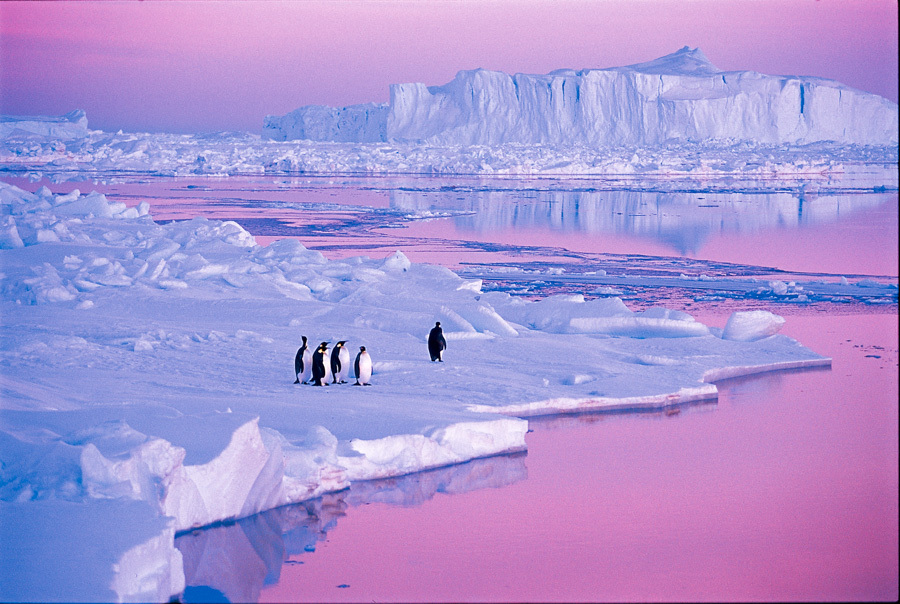
The largest of the Antarctic kingdom is the emperor penguin, dominating its territory with sheer size.
To avoid overshadowing it, the king penguin has settled elsewhere. Once there, it is easy to come across large colonies in South Georgia or the Falkland Islands. Other groups have established themselves on more accessible ground in Tierra del Fuego.
Adélie penguins, with their relaxed manner, parade with a certain elegance across the subantarctic islands. Their mischievous gaze and immaculate plumage give them an almost aristocratic air.
In South America, Humboldt and Magellanic penguins work the coastline, while in South Africa the African penguin is the loudest singer of the lot.
The chinstrap penguin is the most abundant in Antarctica and worldwide. Its name comes from the thin black strap running distinctly under its chin. Its comical bearing and eccentric behaviour bring a touch of life to the ice.
These different species display a range of behaviours, habitats and physical traits, making them a fascinating group of birds adapted to life at sea.

Emperor penguin in the Weddell Sea © Quark – Peter Guttman
A common trap for newcomers:
At the risk of being corrected by specialists, don’t mistake a penguin for an “auk” or call it by the wrong name! Penguins (“manchots” in French) are found only in the southern hemisphere, whereas what the French call “pingouins” — auks — live in the northern hemisphere.
The direct translation of the English word “penguin” into French is, in fact, a false friend.