IN AFRICA, ECOLODGES AND 4X4 VEHICLES ARE GOING GREEN, TO THE
DELIGHT OF SAFARI ENTHUSIASTS.
In Africa, technology moves fast, very fast. Lodges may be lit, showers heated, dishes delicately simmered (without wood fire!), yet the landscape remains unchanged.
And Africa stays Africa, eternal and wild.
The finest sun in the world

Sun over the Serengeti, Tanzania © Tawisa
The secret behind this small miracle, as you may have guessed, comes down to one word: SUN. “In Serengeti National Park, we have the finest sun in the world, at 1,400 metres of altitude, close to the Equator, and without a trace of pollution,” explains Laurent Guillot, founder of Etendues Sauvages. “It would be madness not to use it to produce electricity.” Denis Lebouteux, owner of Grumeti Hills lodge, on the edge of the park, understood this long ago: “we started installing solar panels as soon as the technology appeared, in the early 1990s,” he recalls. The early 1990s — practically prehistory! Since then, solar technology has advanced by leaps and bounds. Today, photovoltaic panels are more powerful and more efficient. Thanks to them, Grumeti Hills can generate 60 kW (equivalent to five or six European households), heat water for the pool and showers, power the kitchen, run the laundry and, of course, recharge the Landcruiser 4x4s converted into electric vehicles.
The spirit of Out of Africa still lingers, now with electricity
Thanks to solar energy captured during the day, the lights stay on well into the night. You can read your favourite novel even in pitch darkness, with the nocturnal stirrings of big cats as background noise. And when you watch the sun set over the endless plains of the Serengeti, the spirit of Out of Africa still lingers.
As for safari enthusiasts, they can observe the great wildebeest migration up close, without the noise of a combustion engine, aboard an electric Landcruiser 4×4. At Grumeti Hills, all vehicles are being fitted with ultra-modern batteries sourced from a German start-up. Range can reach up to 300 kilometres: more than enough for any game drive imaginable. A possibility unthinkable just a few years ago.
Five 4×4 vehicles, zero CO2 emissions
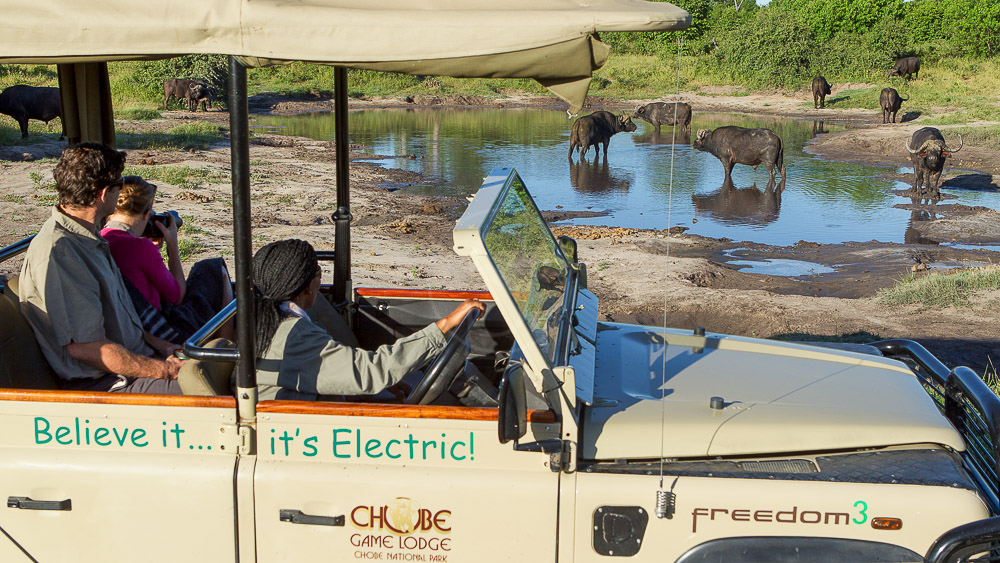
The first safaris conducted aboard electric vehicles took place in Botswana. It happened at Chobe Game Lodge, on the border with Namibia. As early as 2014, this lodge — which, as it happens, hosted Richard Burton and Elizabeth Taylor on their honeymoon! — became the very first in Africa to equip itself with a fleet of electric 4x4s. Two years later, solar panels were installed on the safari boats. The result: zero carbon emissions and a reduction of nearly 40,000 kg in CO2 emissions.
No more need to cut the engine for a photo
Beyond the benefits for the planet, these technological innovations are a boon for safari enthusiasts. With electric motors, the days of jolting 4x4s are over. Driving is smoother and, above all, quieter. It becomes possible to approach animals much more closely, prompting behaviour quite different from what is usually observed.
As in Livingstone’s day

Chobe Game Lodge, Botswana © Desert & Delta
As for the boats, they glide elegantly along the Chobe River, without the slightest engine noise.
In the purest silence, one can’t help but imagine the explorations of Dr. Livingstone, who likely sailed these waters after discovering Victoria Falls — the very same falls that now supply part of Chobe Game Lodge’s green electricity.