Photographing seabirds requires discipline and respect.
Some locations are better suited than others to observing and photographing wild seabirds. Scotland is a prime example, where birds can be approached very closely: Shetland, Handa Island, Bass Rock, Farne Islands…
Start by being very careful and protective toward the birds. Then take in the magic of the setting — the sound of the wind, the sea and the birds. Only then, take a few shots!
Observations generally take place in spring, during the breeding season. Approaching too closely risks disturbing a carefully guarded clutch. Your presence can unsettle one of the parents, drawing predators near the nest.
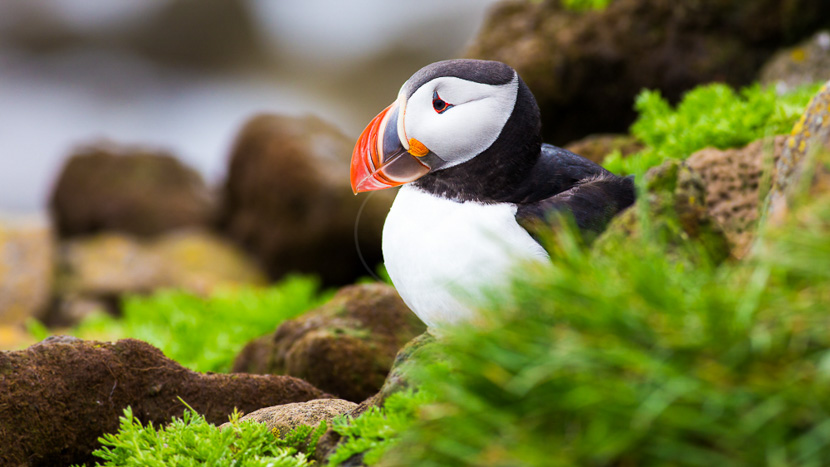
You may also, without realising it, be standing close to a puffin burrow. Staying too long in the same spot can endanger chicks waiting to be fed.
In short, a whole range of behaviours needs to respect this fragile environment. Don’t “steal” a bird photo in a rush — there’s no point to it.
As for the photography itself, focus on the aesthetics of form, the harmony of curves, and behavioural scenes. Concentrate on one or two birds rather than firing away at everything around you.
It takes patience, a great deal of patience, to capture the moment that turns a simple photograph into a great image.
Try varying your framing and focal lengths. Don’t limit yourself to portraits — place the subject within its environment: a puffin on rocks covered in yellow lichen, set against a brilliant blue sky, makes for a striking shot!
Fill flash is also welcome to light up a bird’s eye and lift a few shadows. Use it sparingly.
On the subject of equipment and caution, never forget that weather conditions by the sea can change very quickly, even in midsummer. A poncho and a good jumper are essential!
Finally, never go near the edge of cliffs. They are often very high, very steep, and unforgiving…

Photographic Equipment
Here is a short list of the equipment needed for photographing seabirds:
– DSLR body
– The lens depends on shooting conditions:
-> from a boat, a lens longer than 300/400 mm will be difficult to use.
As the boat is constantly moving, it is almost impossible to frame correctly with a longer focal length.
-> on certain islands, a lens over 300 mm plus a teleconverter will be enough, as you can approach the birds very closely.
-> in other cases, a 500mm is often necessary for tight portraits (though these are not essential).
– 28/70 and 70/200 lenses for wider shots and landscapes.
Accessories
– Waterproof bag or case to protect photographic equipment from sea spray on the boat, or simply from rain
– Dry cloth to wipe down your equipment
– Flash — to be used sparingly
– Tripod with ball head
– Binoculars (high light transmission)
– Sunglasses and high-SPF sunscreen if staying on a boat
– Cap and water bottle