It was Genghis Khan who established Naadam – literally “the games” in Mongolian – in 1206. This festival, whose full name is Eriin gurvan naadam, meaning “the three manly games”, was intended to celebrate victorious campaigns and to train and select the best warriors in three disciplines: wrestling, horse racing and archery. This competition, however, dates back to time immemorial, as nomadic tribes had always competed against one another in tournaments, and it is related to the festival once held in spring as a ritual of renewal.


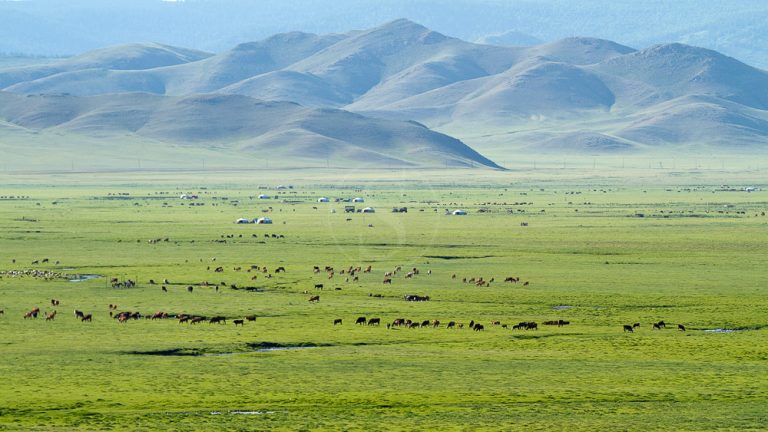
Naadam festival, Mongolia © Etendues Sauvages
Naadam was established as a national holiday in 1921, a few years after Mongolia regained its independence from China. In Ulaanbaatar, the country’s capital, Naadam – both a festival and a national holiday celebrating independence – takes place from 11 to 13 July. It then continues in the provinces throughout the month and serves as an annual gathering for nomads and those who have moved to the city.
This traditional festival was inscribed on the UNESCO Representative List of the Intangible Cultural Heritage of Humanity in 2010.
Naadam is placed under the protection of various gods or guardian spirits through different rituals, such as shamanic dances or warrior dances in the tradition of Genghis Khan. Naadam opens with the transport, by armoured horsemen, of the 9 yak-hair standards representing the nine clans unified by Genghis Khan, to the stadium in Ulaanbaatar where the games are held.
The various disciplines, to which ankle-bone shooting has recently been added, are passed down from father to son within families.
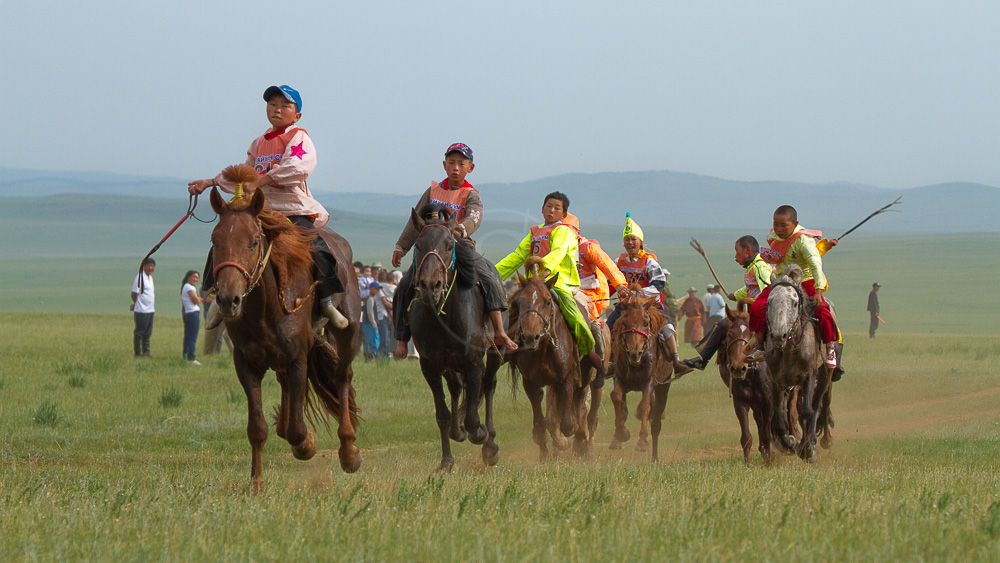
Horse races are organised by category according to the age and breeding stage of the horses. They take place out on the open steppe. During the race, which covers 15 to 30 km depending on the category, young riders – boys or girls aged 5 to 13 – chant a song, the gijngoo, to encourage their mount. The first five horses to cross the finish line are the winners. These horses, as well as the last to arrive, known as the “rich stomach”, receive praise in the form of songs, and their horses are sprinkled with fermented mare’s milk: ajrag. It is the horses and their trainers who receive the honours, not the rider, whose role is considered minor. Winning horses are awarded titles that vary according to their finishing rank and their placing in previous years. Thus a horse that finishes first for the fourth consecutive year is named “the swift mount the tornado cannot catch”.

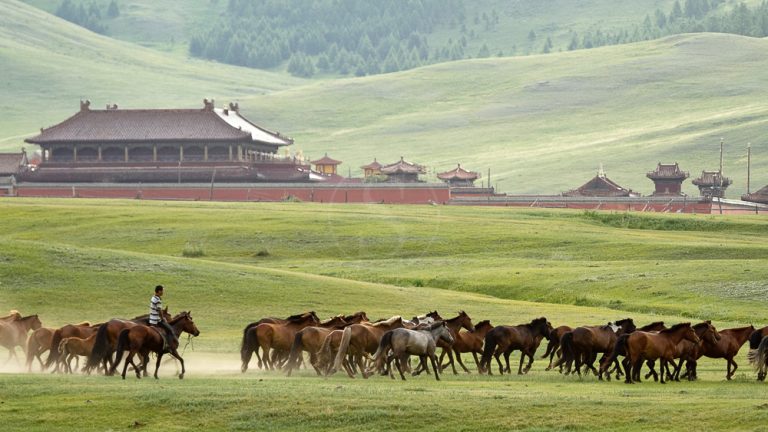
Naadam festival, Mongolia © Etendues Sauvages
Although these are considered “manly” disciplines, women have taken part in archery competitions since the 1940s.
Archers wear the traditional Mongolian costume, called the del.

Naadam festival, Mongolia © Etendues Sauvages
Wrestlers also wear a specific costume: embroidered shorts, a short bolero that leaves the chest bare to prove that the wrestlers are not women, thick boots, and a hat which they hand to their trainer before facing their opponent. They perform an eagle dance before the bout. Only the winner performs it again afterwards.

Naadam festival, Mongolia © Etendues Sauvages
Find HERE our tailor-made travel ideas for Mongolia, or contact our specialists to receive a personalised quote.