“We arrived yesterday. A cloudy sky, jagged ice, dark earth and black water made up the welcoming scene. Everything interlocked, reflected, merged.
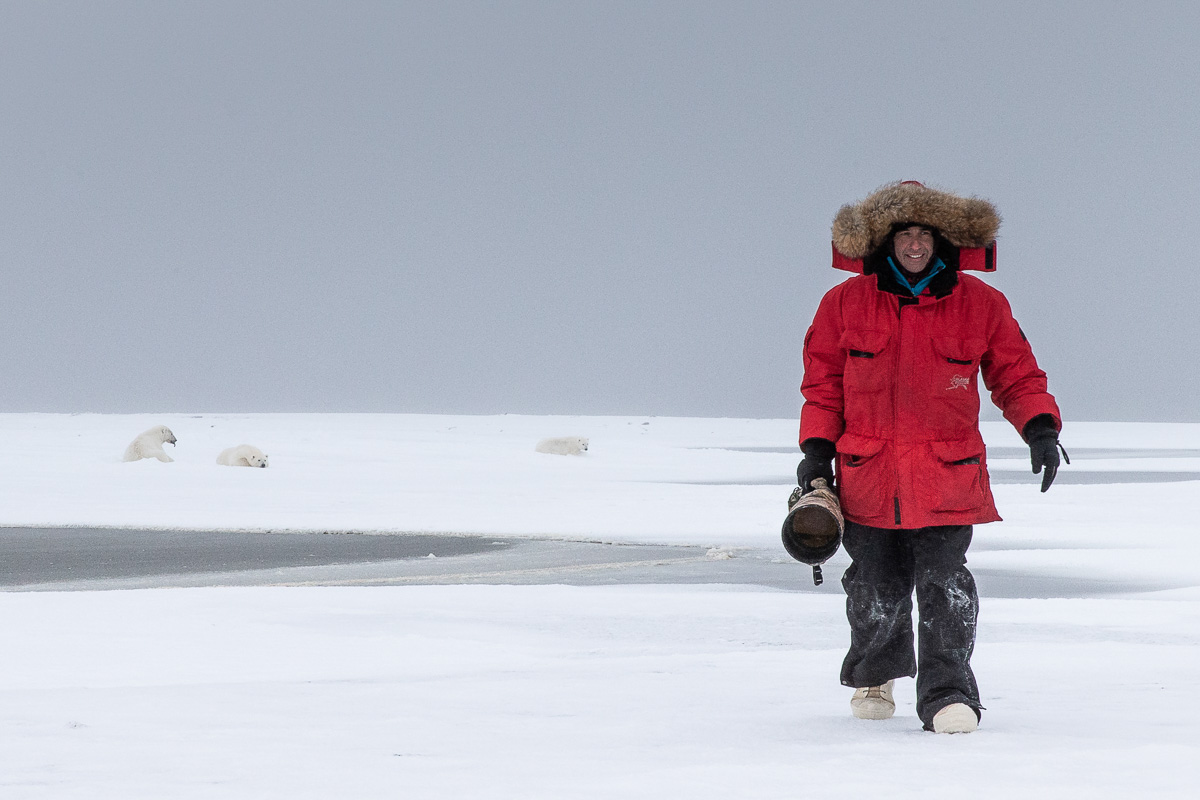
Today, our boat threads its way through thin ice off Spitsbergen, in the Svalbard archipelago. Its red Norwegian flag, trembling in the wind, seems to be the only patch of color in this end-of-the-world landscape. Here, you are far from everything, except polar bears.
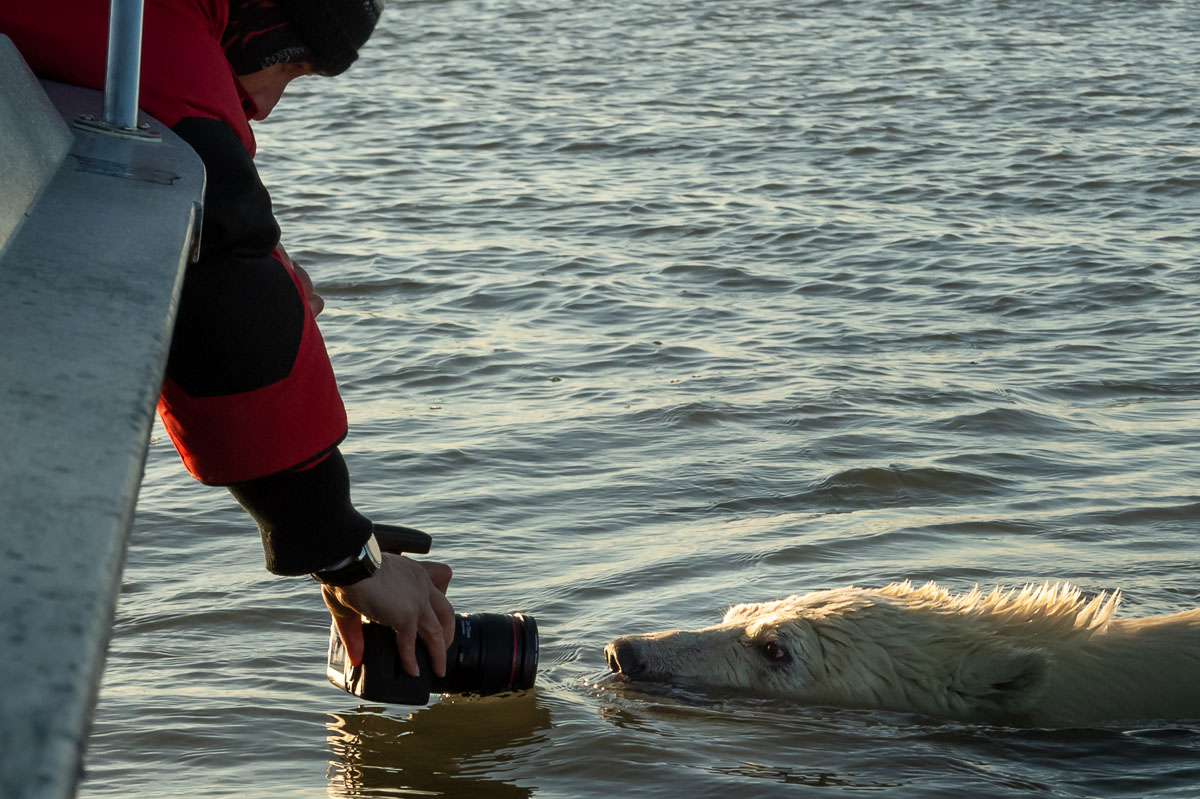
And indeed, we spot a few bears. It must be 0°C. A freezing wind blows across the bay this late morning. Some are swimming to reach the shore. Two others, younger, seem to be dancing on the white stage. The boldest one wants to pounce on the birds at the water’s edge. He hesitates and edges closer to the birds, which pay him no attention at all. That’s when his brother, standing behind him, rushes forward and pushes him into the water. For fun. Like two mischievous boys playing at the edge of a pool. They tussle, roll together, nip at each other, jump, shove one another. Then the bold one gets irritated. He bites his brother harder and goes off on his own. Elsewhere, a mother and her cub watch us. We have no camouflage whatsoever. Yet this is the polar bear. The largest land predator. It fears no one. And it is curious. So the young bear approaches our boat. It wants to observe us. It sniffs the air, to catch our scent. We are outside its frame of reference. It rests its front paws on the boat, the rest of its body still in the water. It cannot haul itself aboard, and that’s just as well. It just wants to be stroked. It presses its nose against my lens. I capture this memorable instant.”
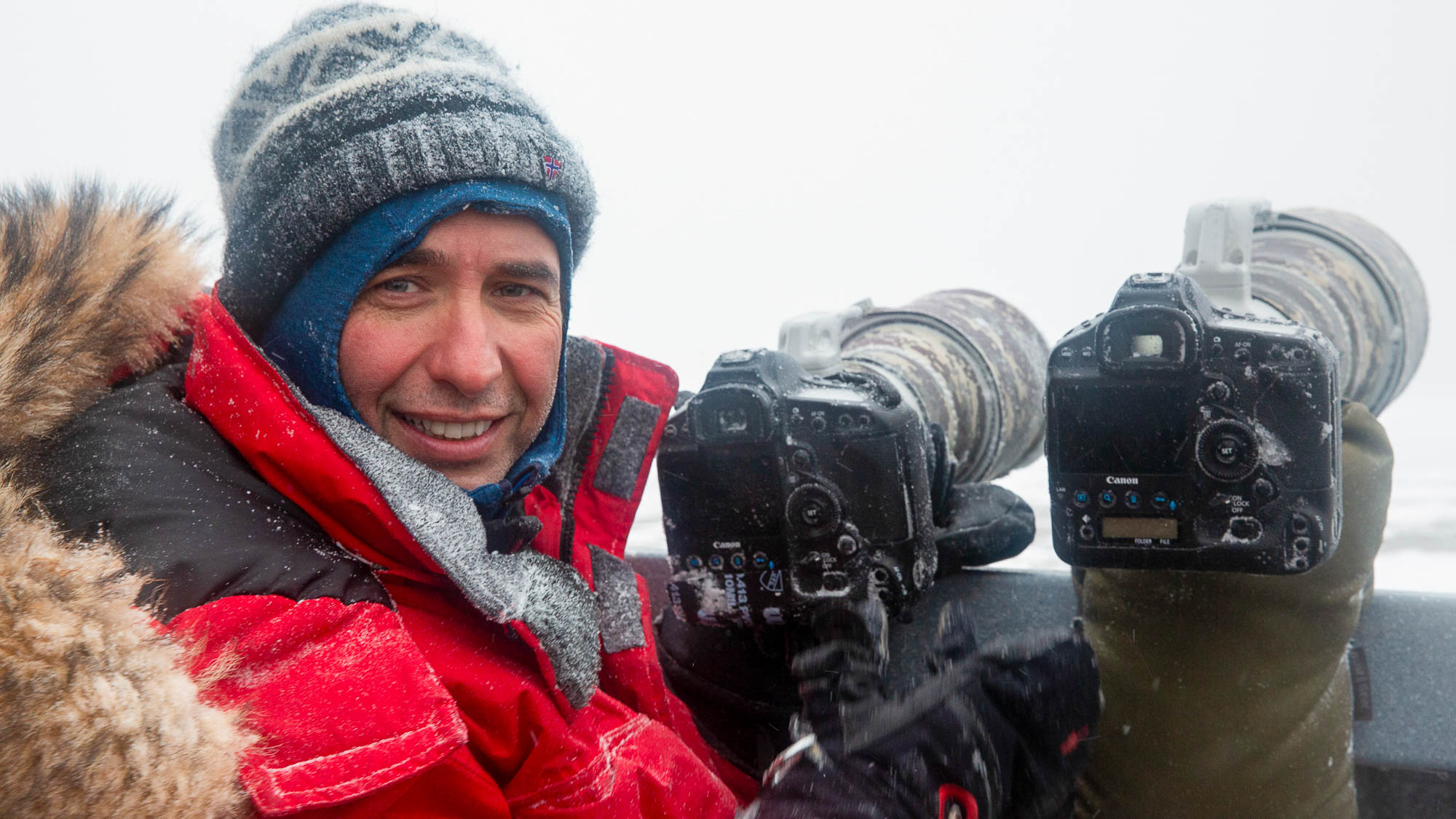
My name is Kyriakos Kaziras. I am a photographer. I love polar bears.
ÉTENDUES SAUVAGES: Your imagination seems to overflow when it comes to polar bears. Is it still fed by that teddy bear you were given for your 6th birthday?
Kyriakos: As a small child, I was passionate about animals, and my maternal grandfather, also passionate about them, took a lot of photographs. I had quite a few stuffed animals, mostly bear cubs, and I’ve always kept that desire to see animals the way I imagined them. So I certainly take photographs with a child’s eye. I’m certainly trying to recreate the imaginary world of my childhood.
If you ever have the chance to observe polar bears in their natural habitat, I highly recommend it. I was moved by the emotion such an encounter stirs. Polar bears are intelligent, sensitive animals, capable of feeling emotions such as joy, sadness and anger.
“AND THEN THE BEAR GIVES YOU PERMISSION TO PHOTOGRAPH IT“
When you meet a polar bear, you get the feeling you are coming into contact with a living being in its own right. Before the photograph, there is the exchange of gazes. You observe each other. Sometimes at length. And then the bear gives you permission to photograph it. That is the moment I wait for. These animals possess a breathtaking beauty, and their presence is an unforgettable experience. A unique experience that stays with you forever. Encountering the bear remains a magical moment, one I wish for everyone.
ES: A photograph begins as a scene imagined in your mind. Yet you’re said to be the photographer of the moment. Do you give in to spontaneity?
Kyriakos Kaziras © Kaziphoto.com
Kyriakos: A great deal of time passes between a photograph and a book or an exhibition. It takes years of scouting, discussions with my Inuit and Inupiaq friends, and groundwork.
I think about my next encounters with the bear — whether on Barter Island, in northern Alaska on the Beaufort Sea, or in Norway on Spitsbergen in the Svalbard archipelago. By spending so much time in these places, I’ve gained a topographical knowledge of them; I appreciate the light there, but also the animal.
Forethought is an integral part of my approach: I try to create a moment, a situation. I imagine a scene and hope to manage to bring it about. Always in the company of an Inuit guide who decides when and how to approach the bear. I am ready, but in the end I control nothing.
I am perpetually guided by the emotion of the moment as it arises.
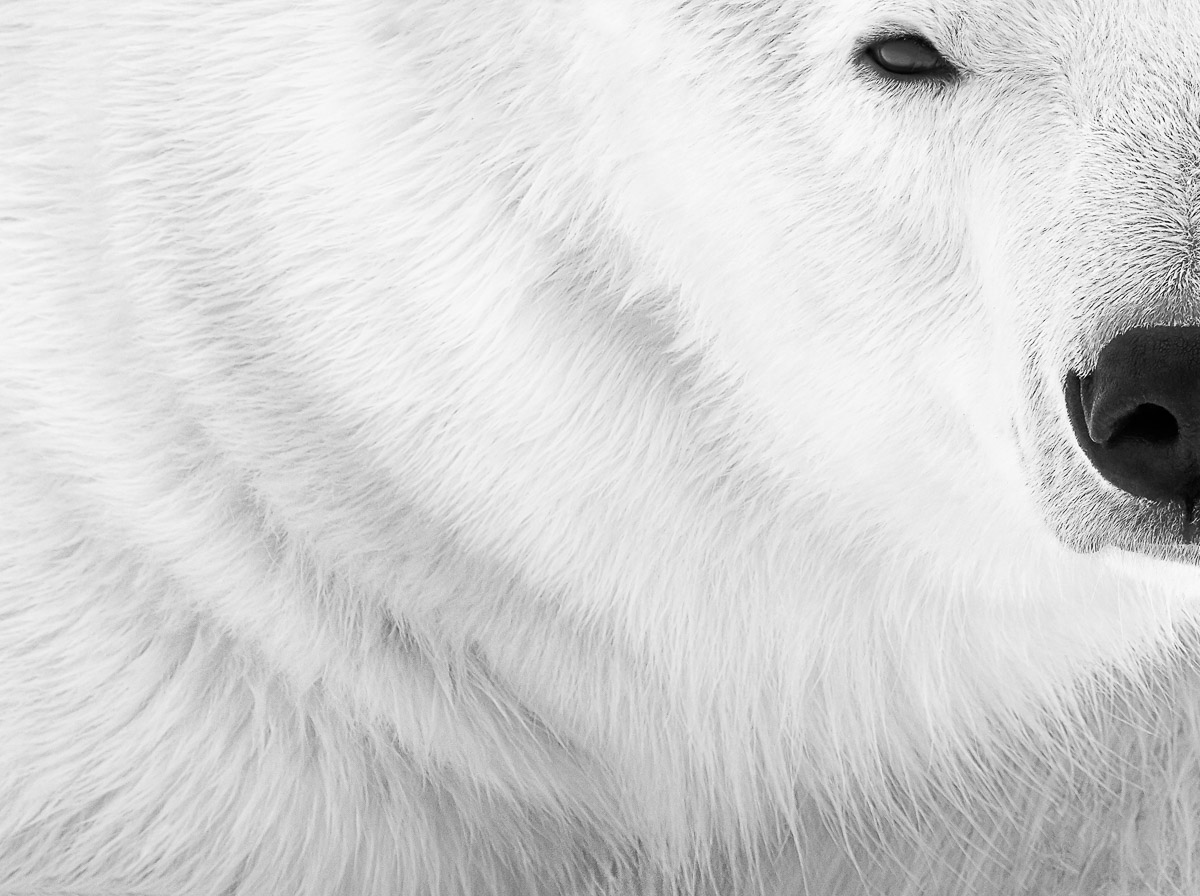
It’s mostly before pressing the shutter that everything happens. I watch the bear, and there is a moment when you feel its soul emerging through its eyes. That is the soul I capture.
For me, photographic work is like filmmaking. When you create an exhibition, you tell a story. It’s like directing a film; a director never just picks up a camera and says “I’m going to make a film.” He has a story to tell, a message to convey. It’s the same for my photography. I often go to the same places, I know the environment, the light. I imagine scenes, and then when I get home, I build a story, I make sketches, and I try to bring them to life. It’s very complicated. In 90% of cases, it doesn’t work. And in 10% of cases, I get roughly what I wanted. That’s why a selection of, say, 70 polar bear photographs represents 3 to 4 months of work a year over 6 years.
ES: What makes a good photograph?
Kyriakos: For a photograph, you have to set technique aside. What ISO, what aperture, what shutter speed, what lens, what camera? That’s secondary. The most important thing is the emotion you feel when you look at a photograph. Everything else is beside the point. Emotion comes first.
There is so much to discover in a photograph, as in a painting. When you let your gaze sink into a photograph, when you enter the image, you’re no longer a spectator, you become a participant.
And since every person is different, no one has the same eye, no one has the same memories, the same life experience. So no one feels the same emotions looking at a photograph. And that’s what makes it wonderful. Everyone takes their own journey.
That’s why a successful photograph is one that gives off emotion.
You have to elevate the ordinary to produce an extraordinary photograph. Not the other way around.
You shouldn’t dwell on the missed shots, but be glad for the one that worked.
I’d like to ask you a question: do you know what the most important part of a camera is? It’s located about one centimeter behind the viewfinder… It’s the person taking the photo! (Laughs)
That’s why the photograph I take is certainly not the photograph another photographer would take under the same conditions. There isn’t just one reality, but several. Photography allows that richness to be revealed. It’s a mirror of the photographer’s culture. One isn’t born a photographer, one becomes one. And to become one, you need to take an interest not only in photography, but also in the arts, painting, literature, music, sculpture, architecture — everything that allows you to appreciate the world differently. So that you can then help others appreciate it too.
Kyriakos Kaziras © Kaziphoto.com
ES: You’re never alone when taking a photograph.
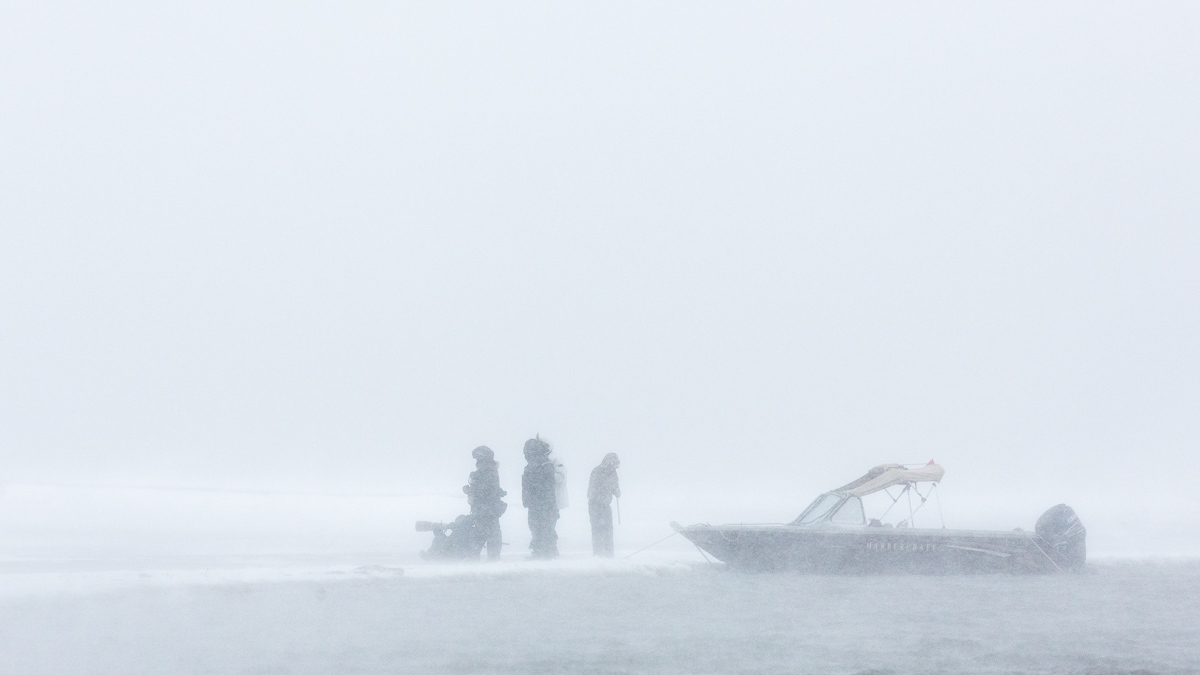
Kyriakos: I’m not an adventurer. And weather conditions aren’t always favorable — that’s putting it mildly! I surround myself with Inuit guides. I trust them. They’re the ones who decide how close we can get to a bear, and whether we need to wait for a bear to come to us. It’s true that over time, returning to the same places leads to routines and to friendships.
Today, when I stay in certain parts of the world, particularly the polar regions, I’m accompanied by people who have become my friends. They know me, they know what I’m looking for, how I work. Our collaboration has become much smoother and easier. That’s deeply appreciated, beyond our friendship itself. I remember once when I was due to travel to Alaska, the friend handling the accommodation had called to book a room for three people in a very modest hotel. The price was $1,000. I told him that was very expensive. That was the remark he made to the hotel owner, adding that for that amount, he could stay in a five-star hotel in Anchorage. The owner replied that he was absolutely right. But that there were no polar bears in Anchorage.
ES: Your work is graphic. Are you the great master of white?
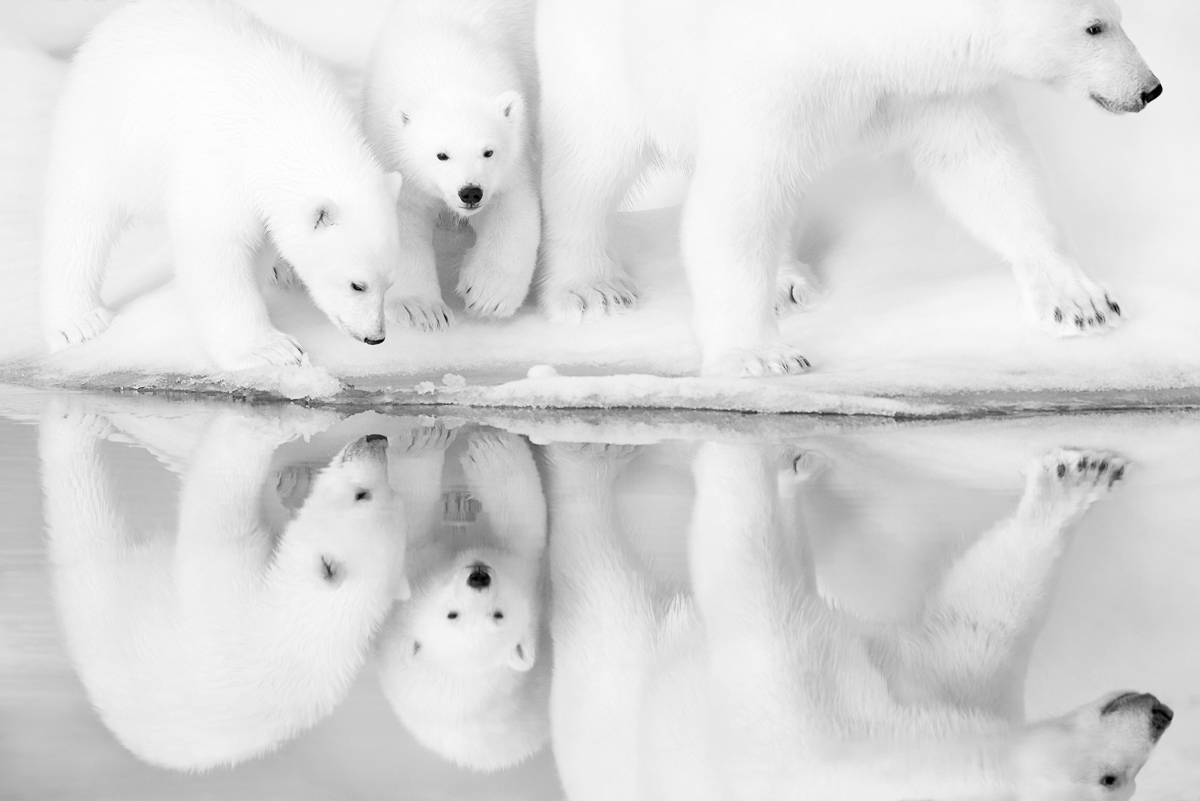
Kyriakos: I don’t just photograph the animals, but also their environment. In Canada, bears are often found on an iceberg or swimming in icy seas. The light there is magnificent. In Alaska, you’ll easily come across families with young cubs. And in Norway, solitary bears hunt on the sea ice. I am in love with wild, untouched landscapes — with their animals and their light.
“THE WHITE OF THE BEAR, THE CHILDHOOD STUFFED ANIMAL, THE PURITY OF ICE AND SNOW“
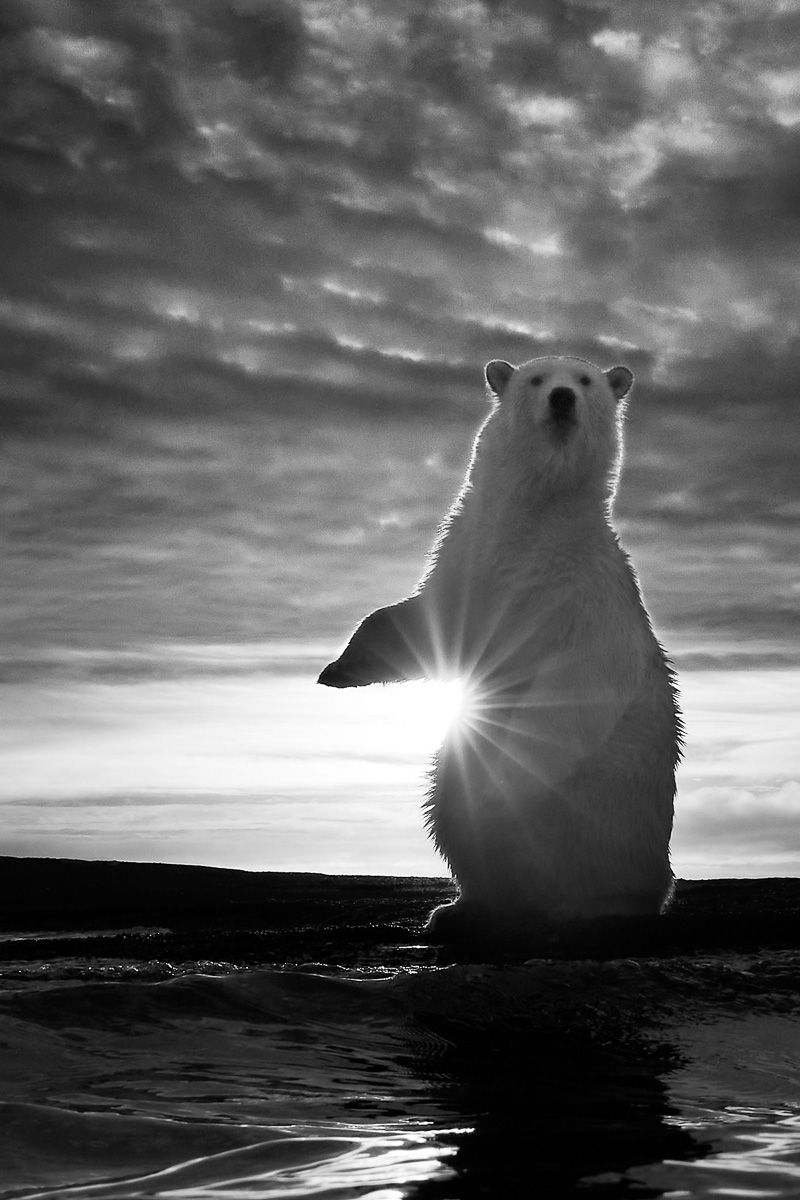
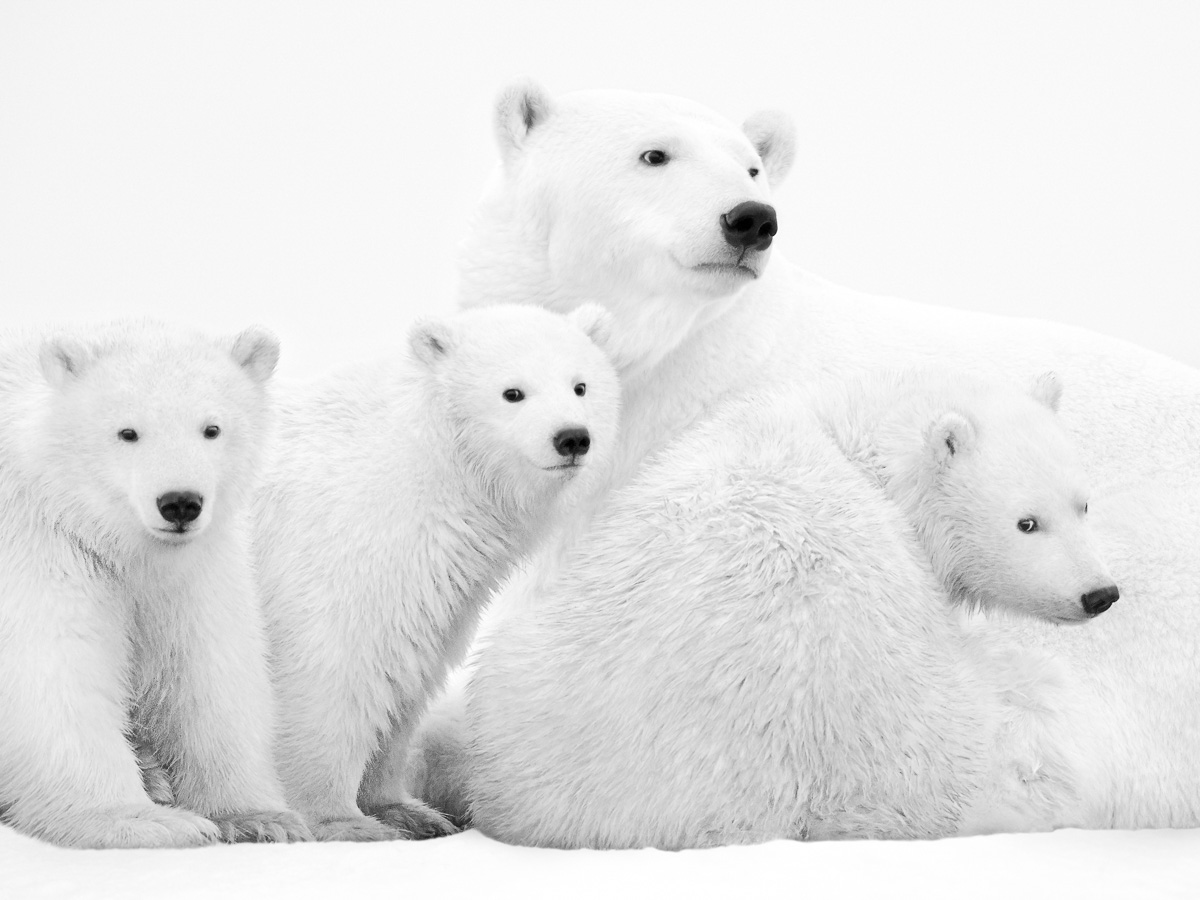
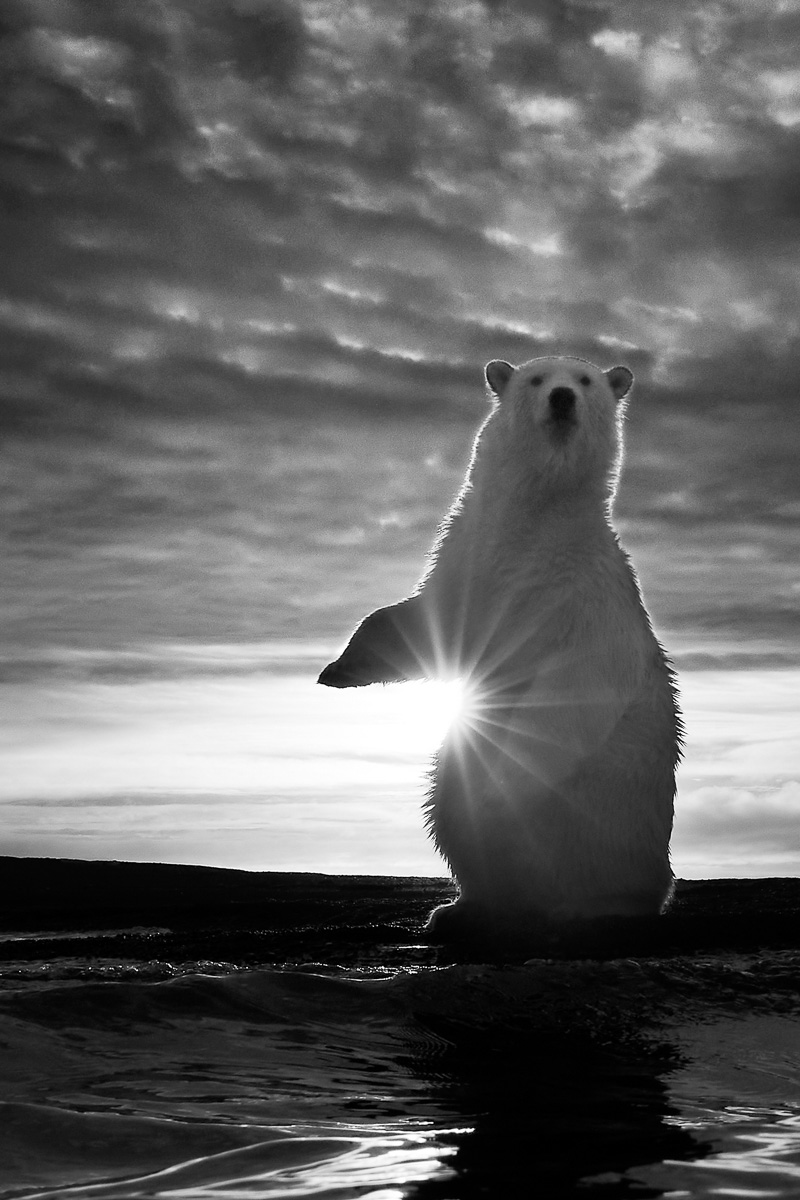
I have a very pictorial approach to photography. I’m interested in the arrangement of shapes within the frame of my photograph. In the presence of light and the way it reveals, the way it brings out what I’m trying to capture. That’s why I place so much value — and spend so much time — on forethought. It matters for composing the image I want. Just as it matters to reveal the purity of nature by magnifying white. To the point of obsession, almost. The white of the bear — the
childhood stuffed animal — the purity of ice and snow. Everything becomes one. Timeless. Outside of time. And the white of the photograph too, bordering on overexposure. And always the light. Intense, like the textured blacks of Soulages.
The subject matters too. It must be immaculate. It cannot have a flaw. Stuffed-animal perfection, once it has you in its grip. I don’t photograph it while it’s eating, or when it’s dirty. It must not have a torn ear, nor a scar from some fight. I make a selection, as if for a fashion shoot. I hold a casting among the bears. To find the one that best matches my reveries of white.
ES: Your images are striking and sublime. What are you trying to achieve with them? Draw attention to a vulnerable species?
Kyriakos: I lean more toward showing beauty than shocking images.
It’s precisely the beauty of the bear that I highlight. To my mind, showing striking, extraordinary images leaves a stronger mark on the viewer’s memory than exposing them to a guilt-inducing vision. My goal is indeed to bear witness to the beauty of the polar bear. It’s a simple idea that’s particularly close to my heart: let’s protect nature and the animals that are part of it. Leaving a positive memory behind is far more powerful and lasting than a shock with immediate but fleeting impact.
As for me, unpleasant memories fade over the months or years. I think that after a certain amount of time, the human brain sets aside everything bad. In the end, we only keep the good memories. The good moments stay with us, they remain. I raise awareness through a magnificent, enduring memory.
Kyriakos Kaziras © Kaziphoto.com
ES: If the images are sublime, some of the captions accompanying them in your books are very poetic.
Kyriakos: “Lonely boy”, “Family walk”, “Bad boys”… When I get home, I can’t bring myself to reduce the bears I’ve encountered to computer file numbers. These encounters are fleeting, but they reveal the animal’s soul. The photographs tell stories. Their story. Giving them captions strengthens the emotion they convey. It’s also a way of inviting the viewer, in a different way, to become an active part of the photograph.
ES: With all your expeditions, you’re a privileged witness to climate change. What effects does this have on the bear in these regions?
Kyriakos: The Arctic sea ice is in bad shape: not only is it shrinking more and more each summer, but its thickness has halved over the past thirty years. Signs of deterioration in the bears’ lives are already visible. The shrinking ice means smaller winter reserves due to less time to build them up, but also reduced hunting grounds and scarcer prey. And as if that weren’t enough, the lack of food also affects the bear during its breeding period, preventing females from having cubs. If one is pessimistic, the polar bear could disappear within a few decades. But while climate change and pollution are both aggravating factors, the leading cause of bear mortality remains trophy hunting, still permitted in certain countries. The opening of certain regions to tourism also disrupts
the balance between man and animal. These regions attract people seeking adventure, strong sensations. As a result, the number of interactions between humans and polar bears keeps rising.
“3000 Polar Bears. 2500 Humans. You are not the King.” This is the welcome message as you step off the plane in Longyearbyen, in Svalbard, the archipelago with the highest density of polar bears in the world. That says it all. Particularly about how close humans are getting to bears. But also about the fact that in Norway — as in Alaska, in contact with the Inuit — humans are just another prey for a bear that has no fear of them. Unlike in Canada, where the bear flees from humans, who are permitted to hunt it.
ES: What was your most recent exceptional moment with a bear?
Kyriakos: He came out of curiosity, to take a look. Enormous and imposing. At first almost invisible to the naked eye, he gradually drew closer to me. He advanced cautiously but with purpose. Eventually ending up just a few meters away. He sat down and looked at me for a long time. Then he left. You should never approach an animal to photograph it, but rather wait for the animal to come to you.
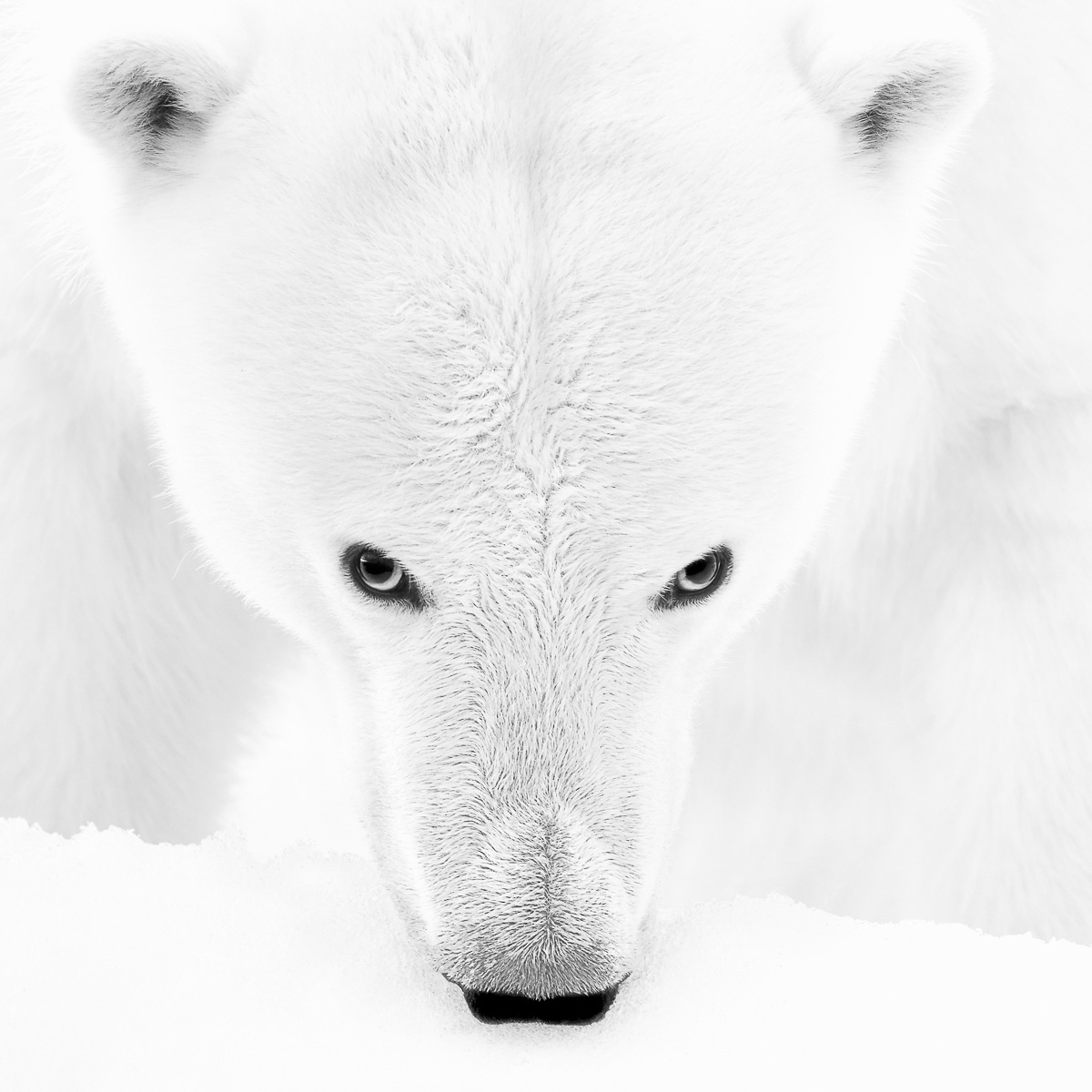
I looked at this bear. We looked at each other. Then he lowered his head, and suddenly, I felt his soul. It searched me through his gaze. And that’s the moment I photographed him. I was hypnotized by his look.
ES: You often run several projects at once. What’s the latest one in the works?
Kyriakos: Not for right away. But a somewhat crazy project. Staging an opera. Where animals would of course have their
place.
Excerpt from the book “At the Heart of Nature – Volume 1”
Interview conducted by Christian Stefani in September 2023, for Étendues Sauvages
BIBLIOGRAPHY
Lions – A by Kaziras, Ramsay
Andarta Princesse de l’Arctique, Ramsay Arctic Emotion, Kazi Éditions
Arktos, Ramsay
White Dream, Ramsay
Elephant Dream, Ramsay
African Dream, Kazi Éditions
Twin cities, Ramsay
New York dream, Ramsay
Masai Mara Magic, Vilo
African lights, Vilo
Predator, Vilo
Mémoires de baleiniers, Vilo
Mémoires d’éléphants, Vilo
Animal Emotion, Vilo