Safari conditions can be demanding and photographic conditions difficult.
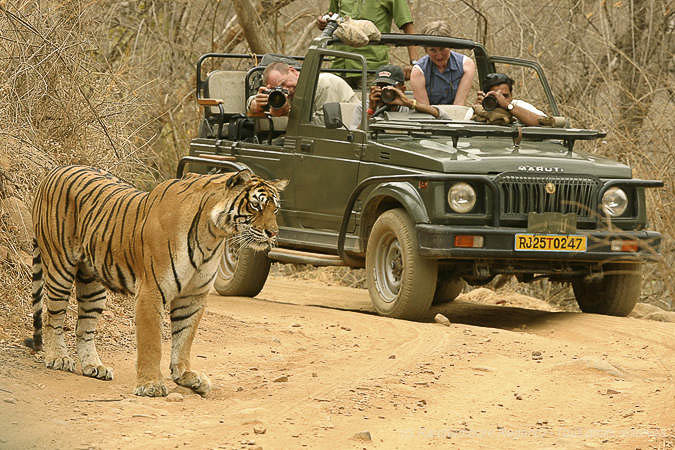
Observing tigers in India is becoming increasingly complicated, tiger numbers are declining year on year and Tiger Reserves are overcrowded, often by Indian visitors themselves. Jeep booking restrictions, allocated tracks or sectors, fixed schedules, etc. The freedom to organise tiger safaris in India is not what you’d usually find in Africa or Latin America. These constraints have to be accepted and the rules followed, or you simply shouldn’t go!
It’s also possible to spend several days in a park or reserve without ever seeing a tiger.
From this point of view, nothing can be guaranteed, whatever mode of travel you choose.
Safaris are run in 4x4s (jeeps) and, in certain reserves, on elephant back. These pachyderms’ backs can’t be described as particularly stable, but it remains the most effective way to spot tigers on rough terrain unsuited to jeeps.
Elephants also have the advantage of approaching animals very closely without frightening them. Long lenses can therefore become unnecessary.
Watch out for the downward angle, which becomes significant when you’re very close to the animal. Wait for a more favourable position. At Bandhavgarh, for instance, the terrain is often rugged. At times, you may find yourself at the same eye level as the tiger.

Tiger Safari in India © Alain Pons
Lenses:
From the 4×4: a 500mm at wide aperture.
A 28/70 for wider shots.

Tiger Safari in India © Alain Pons
Accessories:
– A beanbag can be useful but isn’t always easy to use. A monopod is often more effective here
– A dust-proof, shock-resistant bag to protect equipment in the jeep
– Slightly damp cloths to wipe off dust and protect lenses
– A blower brush to remove dust from lenses
– Binoculars (with good light transmission)
For a tiger safari in particular, we offer a total immersion at Bandhavgarh, including around ten tiger safaris, enough to satisfy even the most dedicated enthusiasts!
Click here to discover other tailor-made journeys in India offered by Étendues Sauvages.
Happy photo safari!