To monitor (track) animal populations, researchers are increasingly using new remote sensing techniques drawn from recent technological advances: drones, bird song recordings, satellite tags… Remote sensing allows the collection of very large amounts of data while minimising disturbance to the environment and wildlife.
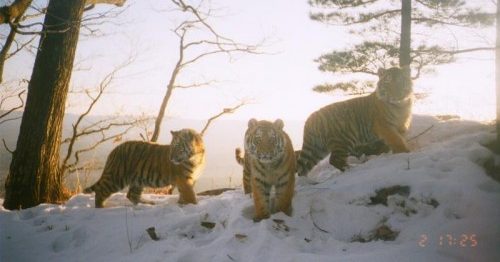
The use of camera traps, often placed in a regular grid across a protected area, is another example. These are cameras that trigger automatically when an animal passes through their field of view. They are left in place for a set period, with images collected at regular intervals. This technique has produced images of rare and elusive species, seldom observed directly in the wild.
From the photographs obtained, researchers can estimate the population size of the species studied as well as other species sharing the same habitat, gather information on their behaviour, identify specific individuals and study their movements, among other things.
As a result, for the past 3 years, the BBC, which has run the Wildlife Photographer of the Year competition for decades, has also organised a competition for the best camera-trap wildlife photo.
BBC Wildlife Camera-trap Photo of the Year 2012

For its part, since 2011 the WWF has used 100 camera traps across 6 nature reserves to study the giant panda. Beyond yielding rare photographs of giant pandas in their natural habitat, the images show, if proof were needed, that protecting an iconic species also helps preserve numerous other species that are less emblematic but equally important for biodiversity.