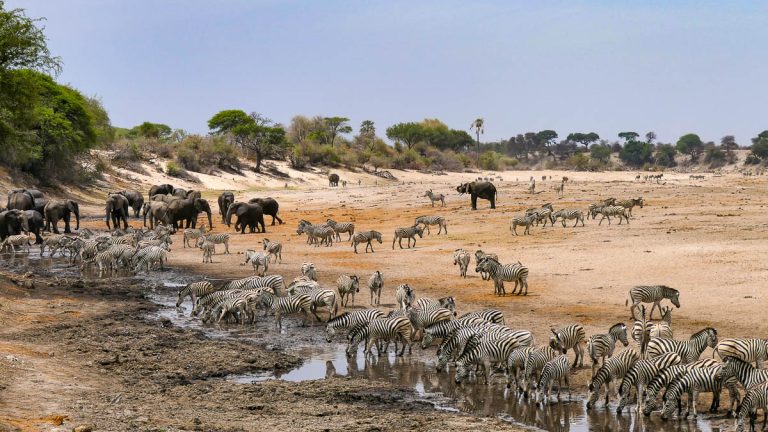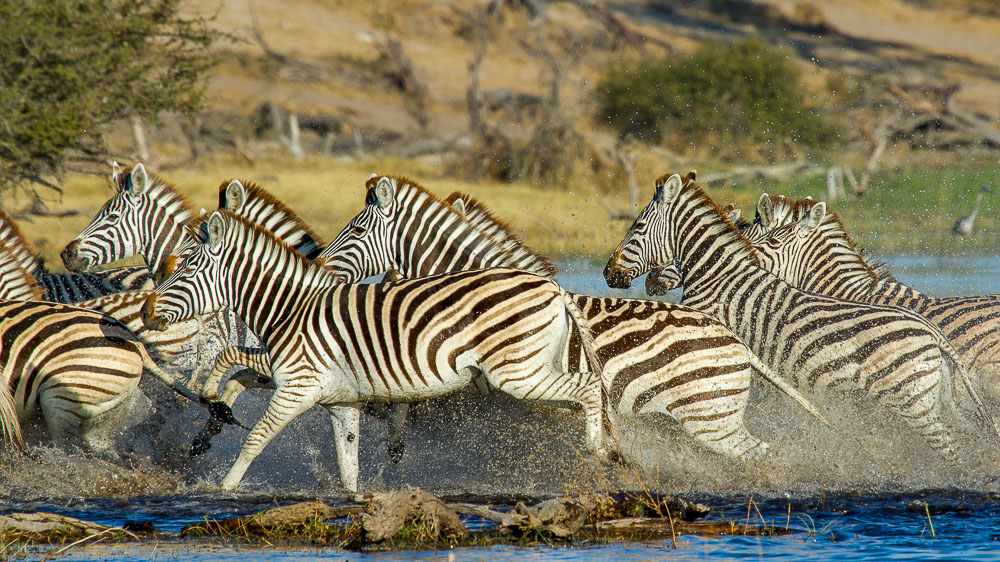
Little known, the zebra migration in Botswana is nonetheless Africa’s second largest animal migration.
At the heart of the Kalahari, more than 20,000 zebras gather there every year.
Unlike the wildebeest migration between Tanzania and Kenya, whose location is fairly predictable within a few weeks, the zebra migration in the Kalahari is more irregular.
To simplify, we can distinguish three variants:
– the first, ancestral, sees zebras moving between the northern Chobe park (where they are generally present between June and November) and Nxai Pan and Baines Baobab parks (where they are normally present between December and February). All of this varies depending on rainfall.
This movement is the hardest to predict, and the length of time zebras spend in Nxai Pan is too short to be certain of observing them there at the expected time. Moreover, this season is not the most favourable for discovering all of Botswana’s highlights in the best conditions.
– the second, also ancestral, sees zebras moving between the eastern Okavango Delta and Makgadikgadi National Park. For centuries, animals made this journey every year. But the construction of a veterinary fence in the 1960s made this movement impossible, causing the death of many animals, particularly buffalo, and changing the habits of others. However, when the fence was partially removed in the late 1990s, some animals — perhaps instinctively — resumed their ancestral habits. This behaviour points to a kind of “genetic” memory, given that none of them had been born before the veterinary fence was built…
Relatively few animals make this journey between Moremi and Makgadikgadi, so this is not the migration we favour.
– finally, a third movement covers a shorter distance, between the Pans and Makgadikgadi National Park. Zebras are found in the south-western part of the Pans during the rainy season (between December and April), then gradually return towards the far west of the national park to stay around the Boteti River between June and the end of October, as the river gradually receives water from the Okavango Delta while the dry season is at its peak.
To observe this migration in the best conditions, we suggest a stay at Leroo La Tau.
On the banks of the Boteti River
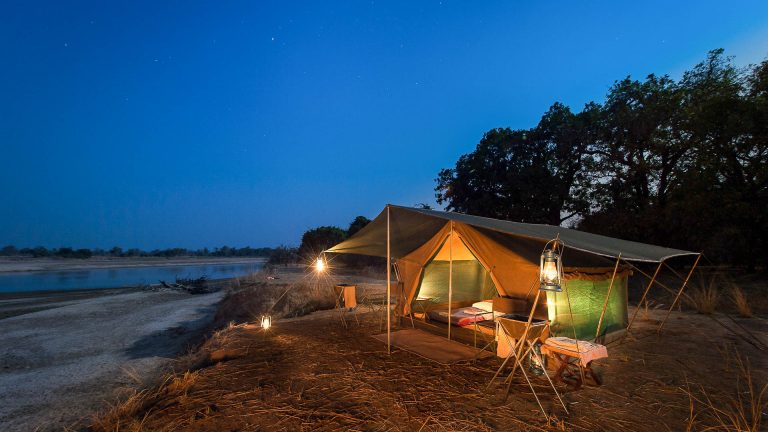
After a light aircraft flight from Maun, giving you the chance to fly over these typical Makgadikgadi landscapes, you’ll stay on the banks of the Boteti River, on the western edge of the national park. Leroo La Tau overlooks the river and the surrounding bush, where thousands of zebras come to drink and graze.
From the chalets built on stilts, with their large bay windows and terraces offering a 270° panoramic view, this camp provides remarkable wildlife viewing, with height giving you a better vantage point.
Zebras are normally present from June to October. This is an ideal period to observe the region’s other animals: lions (Leroo La Tau means “lion’s paw”), as well as brown and spotted hyenas, caracals, wildebeest… and to discover Botswana’s other essential regions such as the Okavango Delta, Savute or Chobe.
We recommend staying a minimum of 3 nights at Leroo La Tau to make the most of the activities on offer: 4×4 safaris in the park and boat safaris (depending on the water level of the Boteti River). You can also take a day trip to Nxai Pan and Baines Baobab to discover unusual and striking landscapes.
Virginie will be happy to design a tailor-made journey for you including this stay at Leroo La Tau.
You can reach her at 01.77.37.03.10 or using our request form.
Note that Leroo La Tau is not located in the Makgadikgadi Pans region, but on the Boteti River at the far western edge of the park. The Makgadikgadi salt pans are on the opposite side and cannot be reached from Leroo La Tau.
For a pans experience, with quad bike, 4×4 or walking outings to meet meerkats, we suggest staying at Camp Kalahari, which, despite its name, is not located in the Kalahari but within Makgadikgadi park itself!
The “Lion’s Paw”, total immersion at the heart of the Kalahari migration