Christophe Courteau is a wildlife photographer, and trained as a biologist, naturalist and geographer.
We have worked closely together since 2008 to, among other things, create tailor-made journeys so that enthusiasts can discover these wild places accompanied by a professional photographer, an expert in the destinations and subjects concerned. Christophe isn’t there to “hold your hand” and simply offer a few photo tips. His presence brings genuine added value. His experience, his know-how, his knowledge of animals and their behaviour, of habitats, of observation conditions, give these journeys another dimension and open up different photographic possibilities.
Among his subjects of choice, Africa’s great apes — and mountain gorillas in particular — hold a special place.
Aurélie and Virginie, our two Africa specialists, put a few questions to him, to satisfy their curiosity. Selected excerpts:
Christophe, you’re one of the most knowledgeable wildlife photographers when it comes to mountain gorillas.
Since when, and how many times have you been to see them?
I’ve been regularly photographing mountain gorillas for 15 years, but how many times in total? I actually stopped counting several years ago, after more than fifty or sixty visits — a little annoyed at the time to only be the second most-visited European photographer. But above all, far behind an English colleague who has been more than 100 times! 🙂
People say that coming face to face with a gorilla for the first time is quite strange, even overwhelming.
How did your first time go?
Indeed, the first time is strange. Everything happens very fast, you’re a bit stressed, you keep repeating to yourself what you want to do, see and photograph. And then nothing goes as planned — the gorillas move, they take cover in the bamboo, and that’s disappointing for the photos, because it’s much harder than expected. But the observation itself remains absolutely extraordinary.
And there, you’re in a kind of altered state.
You have to understand that it’s such a unique moment, one you’ve been waiting for a long time, sometimes for years… There’s an enormous amount of emotion during the first contact, and I’ve seen many people unable to hold back a few tears, overwhelmed by this very powerful, one-of-a-kind emotion.
Seeing the gorillas is often the realisation of a dream. Living that dream can be quite shattering!

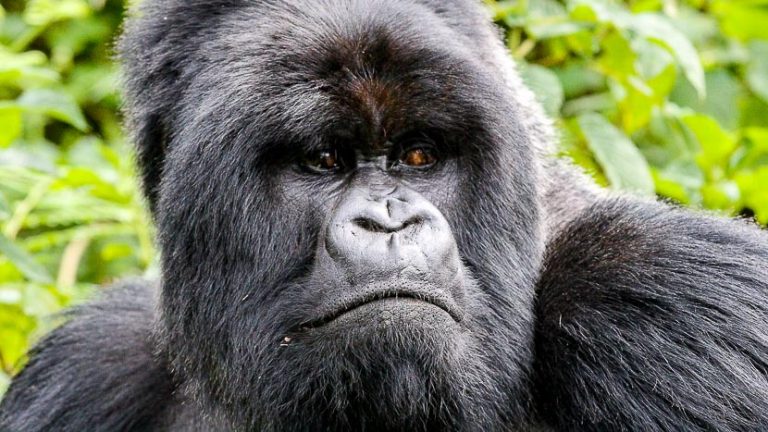
Mountain gorilla, Rwanda © Christophe Courteau
If you had just one piece of advice for someone wishing to meet these gorillas for the first time, what would it be?
Do everything you can to make this dream come true. In our world, which has become somewhat crazy, it must be said, not everyone is given the chance to realise their own dreams. So if you can do it, if you have the physical condition, the will and the financial means, do it while you still can. Don’t wait. Of all the wildlife encounters one can have in nature, being in close contact with a family of gorillas is truly, truly a gift from nature, a rare and obviously very precious moment.
Wildlife and tourism don’t always mix well. What’s your view on this when it comes to gorilla watching?
I take a fairly nuanced view when it comes to tourism and wildlife conservation. It’s become fashionable lately to criticise tourism and air travel. Of course, tourism has a significant impact on nature, and in certain parts of the world, it’s sometimes even a catastrophic one.
But make no mistake, tourism is THE KEY to nature conservation. You obviously can’t do just anything anywhere. Crowded hotels in the middle of the savannah have a significant impact on wildlife and vegetation, that’s certain. But in the case of mountain gorillas, it’s very different.
When it comes to tourism and the protection of mountain gorillas, the Rwandan government took a bold gamble several years ago — one that is proving to be a winning one today.
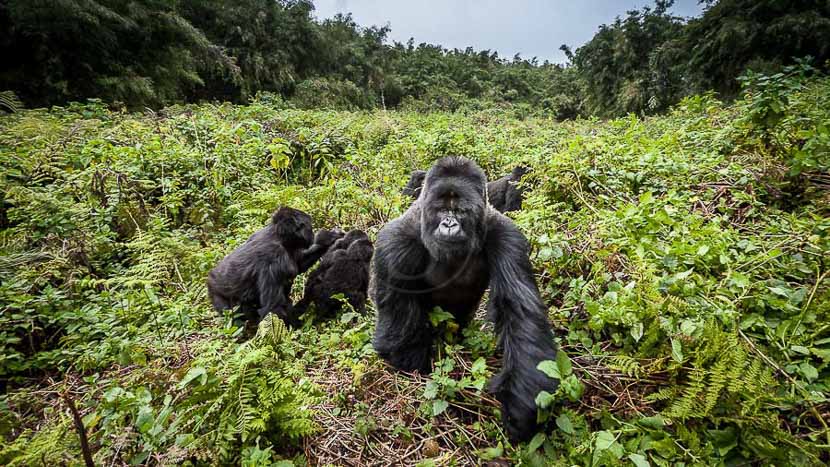
The mountain gorilla families that can be visited in Volcanoes National Park are not numerous, only about ten of them.
The Rwandan authorities have put in place very strict regulations. Everything is perfectly supervised during the treks, in particular thanks to teams of highly trained rangers deeply committed to protecting this species, which is symbolic for their country.
As a result, a maximum of 8 people at a time can visit a gorilla family, for just one hour of contact, once a day.
As you can imagine, we’re talking about an extremely exclusive and tightly regulated form of tourism. And since this summer, with Covid-19, only 6 people in total will be able to go and see the gorillas, under even stricter safety and hygiene conditions, notably wearing a mask at all times — something that wasn’t required in Rwanda until now (though it was in neighbouring Congo).
And yet it’s this very exclusive form of tourism (80 to 100 people per day at most) that has ensured not only the species’ survival, but also its safety and growth. From fewer than 300 individuals in the 1980s, the population now stands at more than 1,000 gorillas.
So the gamble has paid off for the Rwandan authorities, who made the right choice: a specialised form of tourism deeply committed to conserving a species that has been on the brink of extinction for more than 30 years. Today, we can say that mountain gorillas are no longer in immediate danger, but be careful — efforts must absolutely not be relaxed.

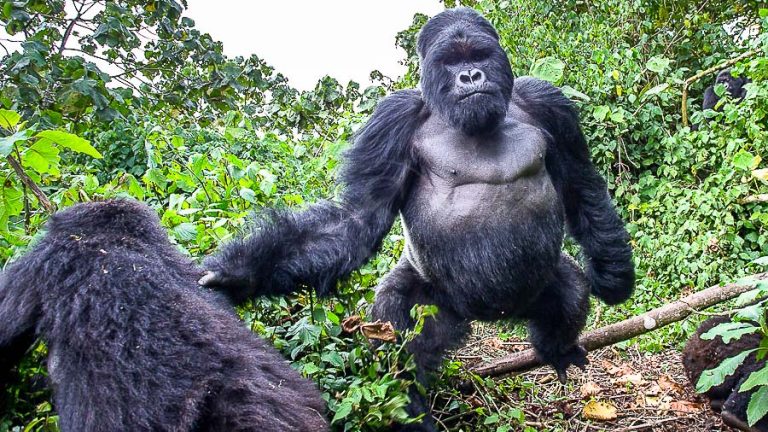
Mountain gorilla, Rwanda © Christophe Courteau
The price of gorilla permits in Rwanda more than doubled three years ago, reaching 1,500 USD per permit.
Do you find this price justified?
I explained earlier that it was tourism that allowed the survival of a species that was nonetheless on the brink of extinction.
If only a very small number of visitors can be accommodated at a time, given the fragile nature of the species and the lay of the land, the consequence is quite simple — it’s mathematical: these few visitors must pay an entry fee at a much higher price than for most activities offered in an African reserve.
But the result speaks for itself.
While most fragile species are disappearing at a rapid pace all over the world, regardless of ecosystem (equatorial forests, savannahs, marine environments, mountains, tundra, etc.), the mountain gorilla population is growing every year.
So much so that Volcanoes National Park in Rwanda has become too small. The gorillas are cramped for space.
For the past 3 years, the government has been gradually expanding the national park by buying back adjacent land that was previously farmed.
This requires considerable financial resources to purchase the land and, above all, to properly compensate farming families and resettle them where they can not only continue their activities but also gain access to public services such as electricity, drinking water, schools and transport — none of which were previously available in these highland villages.
This programme is planned over several years and will obviously require substantial resources. It is mainly the gorilla permits, admittedly very expensive, that fund this park expansion programme and the return to nature of the peripheral areas that were once farmed.
Protecting nature and conserving a species as fragile as the mountain gorilla comes at this price.
Christophe Courteau is trained as a biologist, naturalist and geographer.
In 1995, after some time spent at an applied research institute for agriculture and the environment, he stopped everything and decided to turn his childhood passion, wildlife photography, into his profession. He quickly became a professional photographer.

© Kyriakos Kaziras
Since then, Christophe has never stopped travelling the planet to photograph the animal world in all its beauty and diversity.
But he doesn’t only photograph nature’s most beautiful offerings. Christophe also shows us another reality: most of the creatures and wild landscapes that have inspired so many dreams are fragile and now directly threatened by modern human activities…
Beyond his passion for wild places, Christophe also works on the close ties between traditional populations and their environment.
In his 25 years as a professional, Christophe has also worked as a guide and organiser of photographic journeys in Africa and around the world. In this capacity, he has collaborated with Étendues Sauvages since 2008.
Christophe Courteau’s images have won awards at numerous international photo competitions, including the prestigious “BBC Wildlife Photographer of the Year” and, in France, the Festival International de la Photographie Animalière de Montier-en-Der. But above all, his work has been published by the biggest magazines and newspapers.
From Paris Match and Le Figaro Magazine in France to the famous National Geographic in the US and BBC Wildlife in the UK, his images (and the stories they tell) have often travelled the world, notably his work on African wild dogs and mountain gorillas.
His latest exhibition, “La Nature dans la Peau”, first presented in Montier-en-Der in November 2019 and then in Saint-Germain-en-Laye in January 2020, has already been seen by more than 40,000 people.