The Okavango Delta is highly unusual. The endpoint of a rather unique river, since it flows… into the Kalahari Desert.
Here, without water, there is no life.
This water comes from annual rainfall over Botswana, rain falling on the Angolan highlands (where the Okavango rises), and rain falling across the river’s entire catchment basin. If rainfall is abundant (between December and March), the Okavango Delta’s water level will be high during the dry season, between June and September. Water that is vital at the height of the dry season.
Then, gradually, the water level will drop again, awaiting the new season. A natural cycle that normally runs like clockwork.
But here, as elsewhere, climate disruption is being felt.
For several consecutive years, rainfall was not sufficient to properly feed the delta.
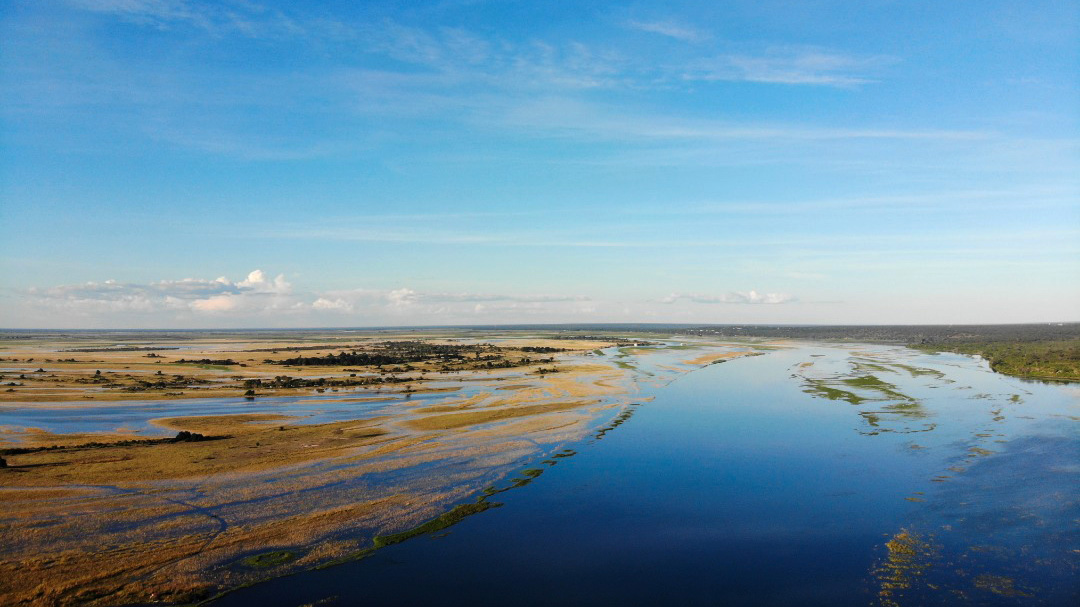
The year 2020 put an end to this shortfall, with a high level of precipitation that made up the deficit by pushing floodwaters beyond the permanent channels, feeding all the so-called “temporary” channels that had been very dry for several years.
Good news: annual rainfall this 2020/2021 season has been exceptionally high, even compared to last year. So when the waters from Angola reach the Okavango Delta, the ground will already be saturated.
The dry season promises to be particularly interesting, as all the channels will gradually fill up. Vegetation will be lusher, grasses more abundant and nourishing, and herbivores better fed and more numerous. Water-based activities (mokoro, flat-bottomed boat) will also run smoothly, so you can experience unforgettable moments in this corner of Africa, often regarded as a small paradise on earth.
The Okavango in a few figures
The river rises in Angola, near Huambo at 1,720m altitude, before continuing its course for over 1,600 km (the 3rd longest watercourse in southern Africa), notably joined by the Cuito and Cubango rivers.
Its catchment basin covers 721,000 km2, significantly larger than the surface area of mainland France.
Following a tectonic shift that occurred 40,000 years ago, the river’s course was altered, shaping a delta that can reach 20,000 km2 at flood peak (4,000 km2 of permanent wetlands).
It takes about 4 months for the water that falls on the Angolan highlands to reach this Delta, whose mouth lies in the Kalahari Desert and which is home to more than 1,000 species of flowering plants and 10 species of ferns. Exceptional biodiversity in a desert!
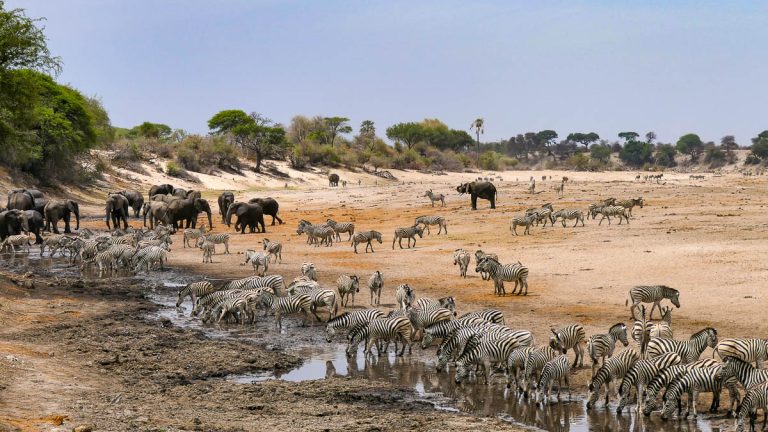
This biodiversity in turn supports equally exceptional wildlife: 130 mammal species, 480 bird species, 208 aquatic species including 90 fish species, 64 reptile species, 94 dragonfly species and 115 butterfly species!
A few examples of tailor-made journeys to Botswana
Safari in Botswana, in &Beyond luxury camps
From Chobe National Park to the Okavango Delta, discover wild nature in a luxury mobile camp and &Beyond lodge.
Your family safari in Botswana
A budding explorer at heart, curious and fearless, your child dreams of a thrilling adventure deep in the bush.
Safari in a private mobile camp and in lodges
A well-balanced journey combining both comfort and adventure… From the Falls to the Delta, mix up the experiences.
Safari in Botswana, from the Okavango to Victoria Falls
An essential safari taking in Victoria Falls, the Chobe River, the Khwai concession or the Moremi reserve, down to a small island in the Okavango Delta.