



Cape Town, South Africa © Shutterstock
South Africa
A country of a thousand faces
Travel to South Africa, for unique experiences
Read more Collapse


We create your tailor-made journey

Why choose a trip to South Africa?
- A WIDE DIVERSITY OF EXPERIENCES
- THE EXCEPTIONAL PRIVATE RESERVES OF KRUGER PARK
- VERY HIGH-QUALITY ACCOMMODATION
- AN IDEAL DESTINATION FOR FAMILIES
- EXCEPTIONAL WILDLIFE AND EXPERIENCED GUIDES
A favourite of ours


Tswalu Kalahari Lodge
By Aurélie, South Africa specialist: “During a stay at Tswalu, one of my dreams came true: meeting the meerkats, in a stunning setting. From first light, we head towards one of the two colonies. We spot an adorable little head, then two, then three, then dozens, watching them move freely around their vast burrows, darting back in the instant the sentinel raises the alarm. A true moment of happiness for me, a confirmed meerkat enthusiast.”
Discover this favouriteConsult us to design your tailor-made journey


Tailor-made travel ideas for South Africa
100% customizable to your wishes
When to go to South Africa
Budget to plan for
Expert advice
Your questions / Our answers
Which vaccinations are mandatory or recommended for South Africa?
No vaccination is mandatory for South Africa unless you have stayed in or transited through a country where yellow fever is present. Depending on the region visited (Kruger, for instance), antimalarial treatment is strongly advised, and we also recommend making sure your routine vaccinations are up to date.
What is the best season to visit South Africa?
The winter season in Southern Africa (from late April to late October) is the best time for wildlife viewing, particularly in the Kruger or KwaZulu-Natal. For the Cape Town region, July to September is the ideal period for whale watching, but the weather can be quite unpredictable, with rain and fairly cool temperatures. November and January are best avoided in the Kruger and KwaZulu-Natal regions.
Is it easy to drive in South Africa?
South Africa is one of the rare African countries where driving a rental car poses no particular issue. Driving on the left is a bit disorienting (especially in town with traffic) but you get used to it very quickly. It’s best to avoid driving at night, whether in town or in the countryside. Some neighbourhoods should also be avoided both day and night, as is also the case in Europe. Common sense and a minimum of caution are enough.
Is the Kruger region too touristy?
The Kruger region is indeed well known, particularly for its safaris. Wildlife is abundant and the safaris are excellent. So yes, this region is touristy. But is that a problem? Not really — you simply need to be savvy, know the area well and be properly advised!
First, a distinction must be made between the private reserves and concessions and Kruger National Park itself.
In the former, only lodge vehicles are allowed to circulate, and you’ll encounter few other vehicles, for exclusive safaris.
Kruger National Park, on the other hand, is open to everyone. It can therefore get busy during peak periods such as school holidays or the dry season, from May to November. The best approach is to avoid the main roads and “get lost” on the secondary tracks instead. Few tourists do this, so you’ll often be the only vehicle in the area — and that’s usually where you’ll make the best sightings. After all, animals don’t like tourists any more than you do!
We like to combine a stay in a private reserve with a visit to Kruger National Park. The experience is entirely different, but just as rewarding as time spent in a private reserve.
Alone in your vehicle, your senses sharpen, alert to a sound, a scent, a track in the sandy trails. And then, there it is, right in front of you. What a reward, what satisfaction, when your own instinct leads you to the sighting!
From what age can children join a safari in South Africa?
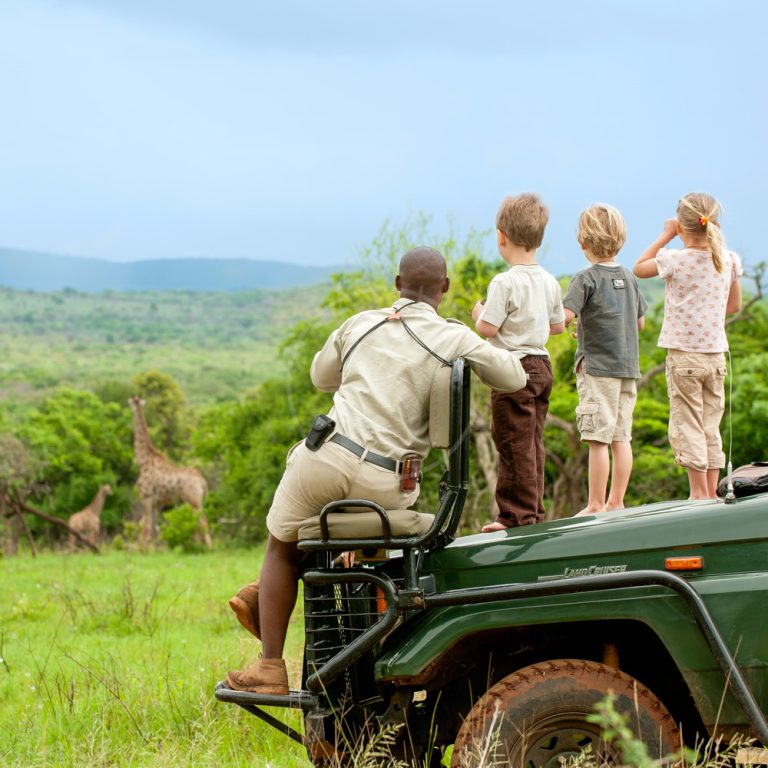
Most private reserves accept children on safari from age 6.
Each lodge has its own rules, however, and some are more flexible.
Children under 12 may only join safaris with the ranger’s approval, depending on the child’s behaviour.
In all cases, lodge guides take no risks during safaris.
Children must remain calm, not shout, and stay seated for 2.5 to 3 hours. Early rising (5:30am) is also required to make the most of the morning safari.
To adapt the safari to your child’s age, some lodges require or offer a private vehicle for the family.
For safety reasons, young children (under 12, or sometimes even 16) are rarely allowed to take part in walking safaris.
A few “children-friendly” lodges organise “mini-safaris” for children under 6, usually around 9–10am, lasting about an hour, fully adapted to younger children by avoiding areas frequented by big cats, for instance.
Activity programmes for children are often available (nature and environment activities, walks around the lodge, arts and crafts, cooking workshops, treasure hunts, pizza parties, etc.). Children may also receive a “mini-ranger pack”, containing a backpack, a colouring book and crayons, as well as an educational safari booklet.
Childcare can also be arranged during activities and mealtimes, sometimes at an extra cost.
To fully enjoy safaris together as a family and have a wider choice of reserves, it is nonetheless preferable to wait until your child is 6, as this allows for better adaptability and attention span, making the experience more enjoyable for the whole family.
South Africa is without doubt one of the most suitable countries for a first safari with young children.
Indeed, no vaccinations are mandatory, and certain reserves such as Kwandwe and Madikwe, as well as regions such as the Cape, carry no malaria risk.
Moreover, the Cape region allows for activities beyond safari, offering variety in both experiences and wildlife (penguins, whales) to keep your children’s curiosity engaged.
It is also possible to plan a less itinerant trip in South Africa than in East Africa, by staying several nights at lodges offering both a morning and an afternoon safari, allowing your children to enjoy the pool or rest during the day.
Is it dangerous to travel in South Africa?
The media report a lot about insecurity in South Africa. However, the country is no more dangerous than certain neighbourhoods in France or Europe. It is just as unwise to visit this type of neighbourhood there as it is here. It comes down to common sense.
In South Africa, common sense means leaving nothing visible in cars, not wearing valuables, and avoiding walking around at night, preferring a taxi for dinner outside the hotel.
Some cities are more dangerous than others. The Cape region and the Kruger region are very safe, though certain neighbourhoods in larger cities such as Johannesburg or Durban are best avoided. As specialists in Africa for many years, the addresses and itineraries we propose always take this into account.