Christophe Courteau’s knowledge of Africa speaks for itself, and he could talk for hours about Uganda, Rwanda and great apes, recounting memories from his travels. Here are a few selected excerpts.
When did you first go to Uganda and Rwanda, and how many times have you been back since?
I first went to Rwanda in February 2005 and to Uganda in April 2006.
Honestly, I’ve lost count of how many times I’ve been back to Rwanda or Uganda since—more than a dozen, certainly, and some years I went several times. As the saying goes, “when you love something, you don’t count”…!
Your most memorable experience with chimpanzees in Kibale?
As is often the case, the most memorable experience with chimpanzees was my very first encounter. It was one afternoon, just after a light rain. We’d been walking through the forest for a while and were approaching a group of chimpanzees whose calls had given away their position. But according to my guides, these calls were highly unusual—very intense, very frequent.
The chimpanzees were clearly agitated, and they were letting the whole forest know it.
We got closer, to within a few metres. We could hear them without seeing them, yet they were right there, close by—we could hear their calls and even their movements on the ground, when suddenly I spotted my first chimpanzee through a gap in the vegetation.
He was only about twenty metres away, walking on the ground, and I couldn’t see him very clearly. Then he stood up on his hind legs, picked up a branch and rested it on his shoulder almost like a spear, advanced a few steps like that while looking into the distance, then dropped back down to the ground to continue on all fours.
The scene lasted only a few seconds, but that image has never left me, because I immediately connected it to the pictures from my childhood books on early humans. It’s by far one of the most fascinating encounters of my entire career as a wildlife photographer.
In fact, that day we found ourselves in the middle of a pitched battle between two chimpanzee clans fighting over territory.
And with gorillas?
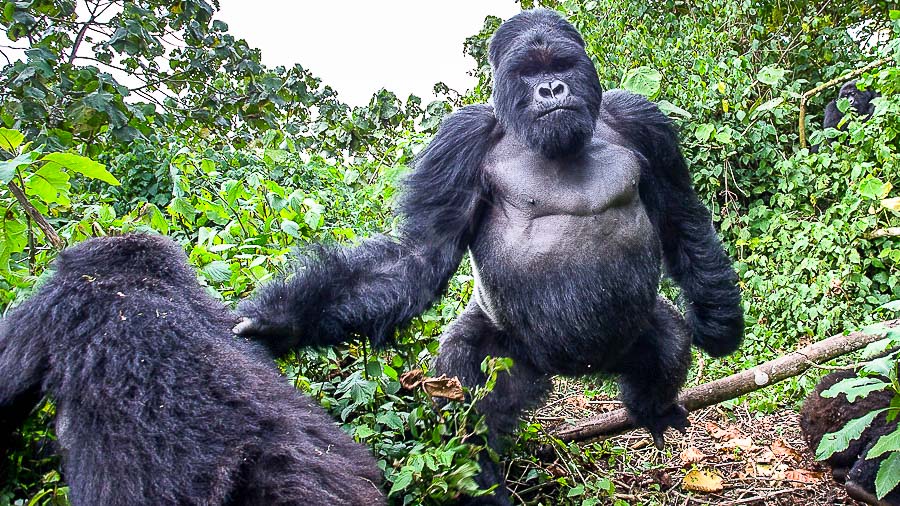
With gorillas, it’s different. Of course, the first one you see leaves quite an impression. Over the past 10 years, I’ve done more than fifty treks to see gorillas, so I’ve lived through plenty of memorable moments. But without question, the moment that struck me most was when a silverback, Akarevuro, the dominant male of the Kwitonda group, charged and sent me flying into the vegetation while I was photographing him with a wide-angle lens. I barely had time to react before he was already past me!
The photos taken that day travelled around the world, because a charging silverback is always an extremely impressive sight, even though gorillas are harmless.
In your view, what is the best site for observing and, above all, photographing mountain gorillas?
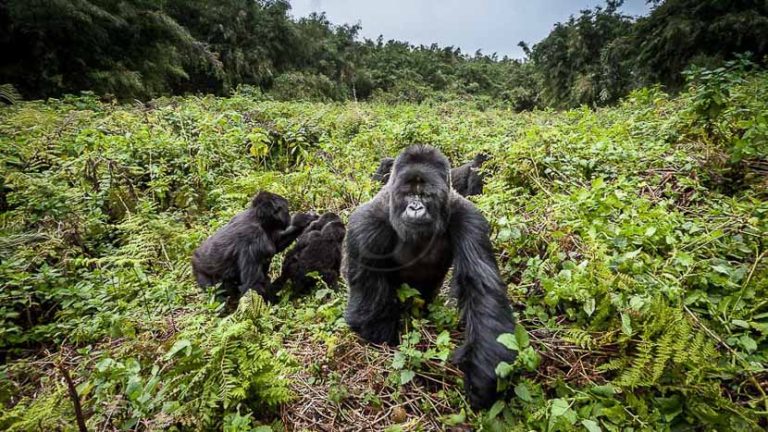
Mountain gorilla, Rwanda © Christophe Courteau
I’ve photographed gorillas in Rwanda’s Volcanoes National Park, in Congo’s Virunga National Park, and in Uganda’s Bwindi Impenetrable Forest. All of these experiences are remarkable, but Rwanda is definitely where you can best observe and photograph mountain gorillas.
There are many habituated groups you can visit, and the logistics run by the National Park teams are genuinely professional and thorough. And the results speak for themselves: the conservation policy Rwanda has put in place is paying off, since when I first travelled there, there were only around 500 gorillas—today there are 880.
It’s a real success story.


Three tips for not missing your gorilla and chimpanzee photos?

Photographing gorillas in Rwanda © Christophe Courteau
The first tip is to set off in good physical condition. The approach isn’t easy—for gorillas, they’re not called mountain gorillas for nothing… and for chimpanzees, even though the elevation gain is less, they move around a lot through dense forest, so you need to be able to keep up with them.
Next, you need solid, simple and lightweight photographic equipment. There’s no need to burden yourself with large telephoto lenses for gorillas, which you approach quite closely. As a general rule, a wide-angle zoom on one camera body and a 70–200mm type zoom on a second body will let you cover practically every situation.
With chimpanzees, it’s different. Shooting distances can be fairly long, in which case a long telephoto or a 500mm or 200–400mm type zoom becomes necessary. A monopod is very useful here, since the forest is dark.
Finally, it’s best to favour cameras that can handle high ISO settings well, which recent camera bodies do very effectively.
Images at ISO 4000 are not uncommon in Kibale Forest, especially when trying to capture action and behaviour.
Christophe Courteau trained as a biologist, naturalist and geographer.
In 1995, after some time spent at an applied research institute for agriculture and the environment, he gave it all up and decided to turn his childhood passion, wildlife photography, into his profession. He quickly became a professional photographer.

© Kyriakos Kaziras
Since then, Christophe has never stopped travelling the planet to photograph the animal world in all its beauty and diversity.
But he doesn’t only photograph nature at its most beautiful. Christophe also shows us another reality: most of the creatures and wild landscapes that have so captured our imagination are fragile, and are now directly threatened by modern human activities…
Beyond his passion for wild places, Christophe also works on the close ties between traditional communities and their environment.
Over his 20 years as a professional, Christophe has also worked as a guide and organiser of photographic journeys in Africa and around the world. In this capacity, he has collaborated with Etendues Sauvages since 2008.
Christophe Courteau’s images have won awards in numerous international photography competitions, including the prestigious “BBC Wildlife Photographer of the Year” and, in France, the International Festival of Wildlife Photography in Montier-en-Der. Above all, his work has been published by major magazines and newspapers worldwide.
From Paris Match and Le Figaro Magazine in France to the renowned National Geographic in the United States and BBC Wildlife in the UK, his images—and the stories they tell—have often travelled the world, notably his work on African wild dogs and mountain gorillas.
Discover his images on his website.
A few examples of journeys designed by Etendues Sauvages that he accompanies.
And his latest film, offering a glimpse of the photographic journeys we design together