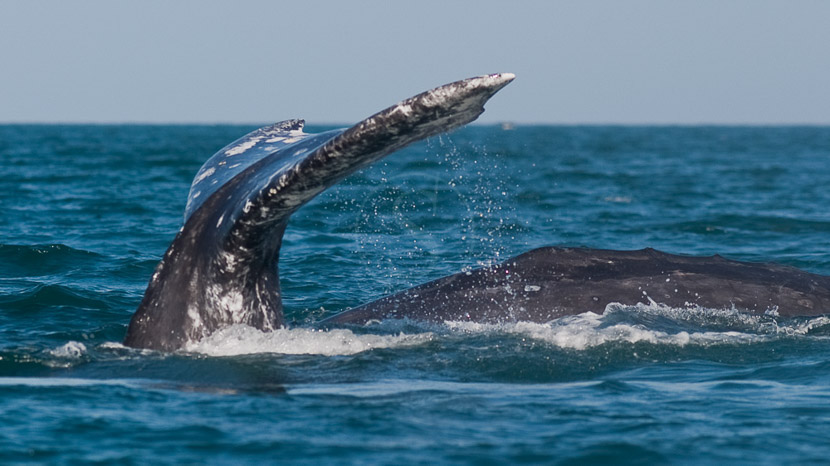
Whale watching from a small zodiac-type boat doesn’t make photography easy.
Here are a few tips…

Lenses and focal lengths
There’s no need for overly long focal lengths — the boat’s instability makes framing very difficult above 200mm. The ideal is a stabilised lens such as a Canon 100-400 or Nikon 80-400. Optical stabilisation makes framing far more comfortable.
Speed
You need both a very fast autofocus and a shutter speed quick enough to avoid motion blur and freeze the movements of whales or dolphins.
A whale or dolphin breaching the surface lasts only a few tenths of a second. It happens very, very fast…
The best approach is to set your camera to Tv mode (shutter priority) at a minimum of 1/500s or 1/750s.
Consider a fast lens or a high ISO setting if you want to shoot at dawn or dusk, when the sun sits very low on the horizon.

Horizon
It should be level, and the rule of thirds matters more than ever (easier said than done on a pitching boat!).
Filters
A UV filter is essential (a polarising filter is optional).
You can also use a filter to reduce the blue cast caused by the sea, or adjust your camera’s white balance.
If you shoot in RAW, you’ll be able to adjust this balance later, when selecting your images.
Quick reminder: never more than one filter at a time!
Accessories
– A waterproof bag or case to protect your camera gear
– A dry cloth to wipe off sea spray
– A monopod to steady your shot (not always very practical)
– Binoculars (avoid magnifications above eight, as stability becomes an issue)
– Sunglasses and high-SPF sunscreen
– A cap and a bottle of water!!!
The ultimate extra!
– An underwater sound recorder, to listen to whale song. 🙂

Watching and photographing whales
Being close to these impressive marine mammals is always a powerful experience…
If encountering them is a dream you’d like to fulfil, take a moment to explore a few examples of tailor-made journeys designed by Etendues Sauvages:
To meet grey whales in Baja California, Mexico, click here!
See here an example journey for observing humpback whales in South Africa.
Or perhaps a sea kayaking trip appeals to you, on the Valdés Peninsula in Argentina… there too you’ll have the chance to encounter and admire the southern right whale, the largest mammal on the planet!
The Etendues Sauvages team wishes you a safe journey!
Feel free to explore the site further and contact our team with any questions.